
Did you install a drip irrigation system and now you’re wondering how long to set the timer for? It’s a common struggle for gardeners because the short answer is: It depends.
But if I had to make an educated recommendation, I’d say: Start with 40 minutes, observe, and adjust.
There’s a lot more to it though, and observing and adjusting is key to making sure your plants get enough water.
You’ll find lots of other baseline suggestions online but the truth is, how long (and how often) to run your drip irrigation system depends on several factors:
- Emitter spacing
- Flow rate of emitters
- Water pressure
- Size and type of plant being watered
- Soil texture
- Climate (temperature, wind, rain, etc.)
So calculating the exact time that you should run your drip irrigation isn’t possible, but you can get close enough with my interactive Run Time Calculator (below).
I designed the calculator to help you determine how much water your garden requires and how long your drip irrigation needs to run to deliver that amount. It’s not a perfect calculation because it doesn’t factor in your soil type or climate, but you can use the recommended run time as your starting point.
Drip irrigation run time calculator
How to use this tool
The drip irrigation calculator gives you an approximate run time per watering session.
You will need to know three things to determine the run time:
- Irrigation Area, measured in square feet
- Water Depth, measured in inches
- Area Flow Rate, measured in gallons per hour (GPH)
Irrigation area
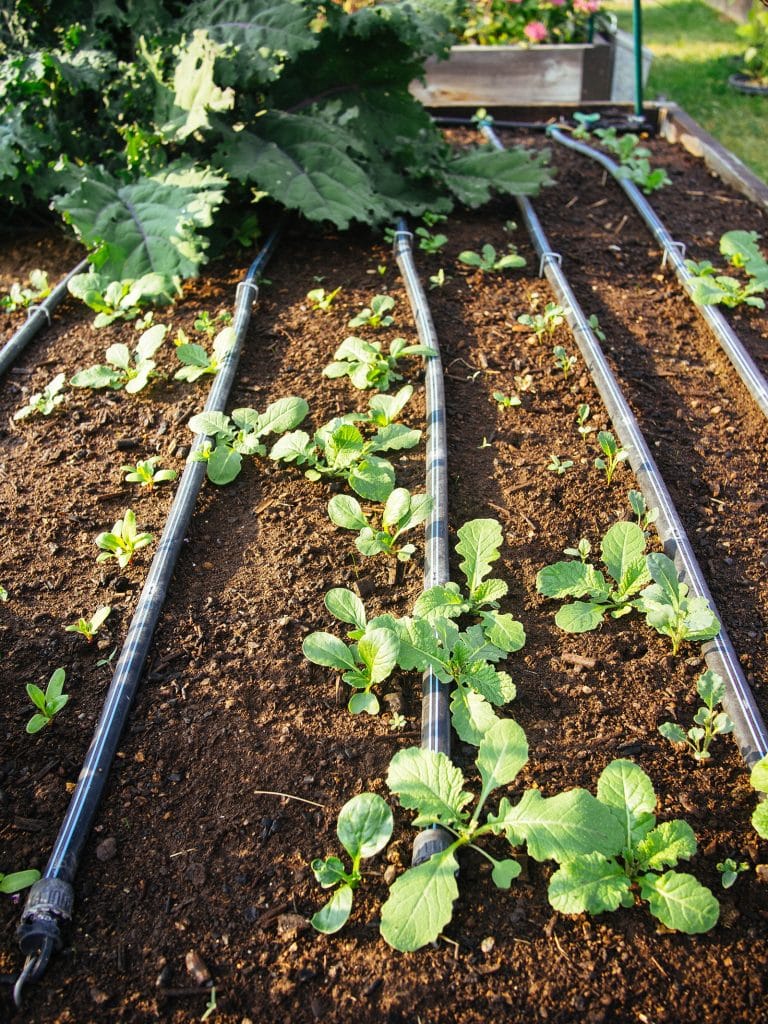
Irrigation area is the size of the zone being watered, which can be raised beds, in-ground garden beds, or even container gardens.
Calculate the irrigation area by multiplying the length by the width.
Water depth
Water depth is the desired amount of water penetration per week. If you grow vegetables, the usual rule of thumb is to start with 1 inch of water a week, but the actual amount depends on climate, soil type, sun exposure, and plant maturity.
Use the table below for a general guideline on how many inches of water your plants might need per week. Divide that figure by the number of watering sessions each week to determine the “water depth” for the calculator.
Pro tip: If your soil is sandy or your garden is in full sun all day, go with the higher end of the water range. If your soil is clay or your garden is partially shaded, go with the lower end.
|
Plant type |
Cool climate (inches/week) |
Moderate climate (inches/week) |
Hot/dry climate (inches/week) |
|---|---|---|---|
|
Vegetables |
1 – 1.5 |
1.25 – 1.75 |
1.5 – 2+ |
|
Flowers |
0.75 – 1 |
1 – 1.5 |
1.25 – 1.75 |
|
Shrubs |
0.5 – 0.75 |
0.75 – 1.25 |
1 – 1.5 |
|
Trees (established) |
0.5 – 1 |
0.75 – 1.25 |
1 – 1.5 |
Area flow rate
Area flow rate is the sum of the flow rates of all emitters in the irrigated area. The flow rate is usually printed on the emitter or packaging and looks like 0.5 GPH, 1 GPH, 2 GPH, etc.
Keep in mind that flow rates vary by water pressure (psi). The specifications of that emitter should either tell you what psi the flow rate is listed at, or give you a range of flow rates at 10 psi, 20 psi, 30 psi, and so on.
Most drip irrigation systems require a pressure regulator to ensure the water pressure is low enough for proper operation (typically 20 to 30 psi). You’ll get a more accurate calculation if you know the psi of your system.
To determine the area flow rate, count the number of emitters in that area and multiply by the flow rate per emitter (GPH).
Calculation example
Let’s say your garden bed is 4 feet wide by 8 feet long, so 4 x 8 = 32 square feet.
The water depth needed for your vegetables is 1.5 inches per week. Your plants are still small and require watering three times a week, so 1.5 ÷ 3 = 0.5 inch.
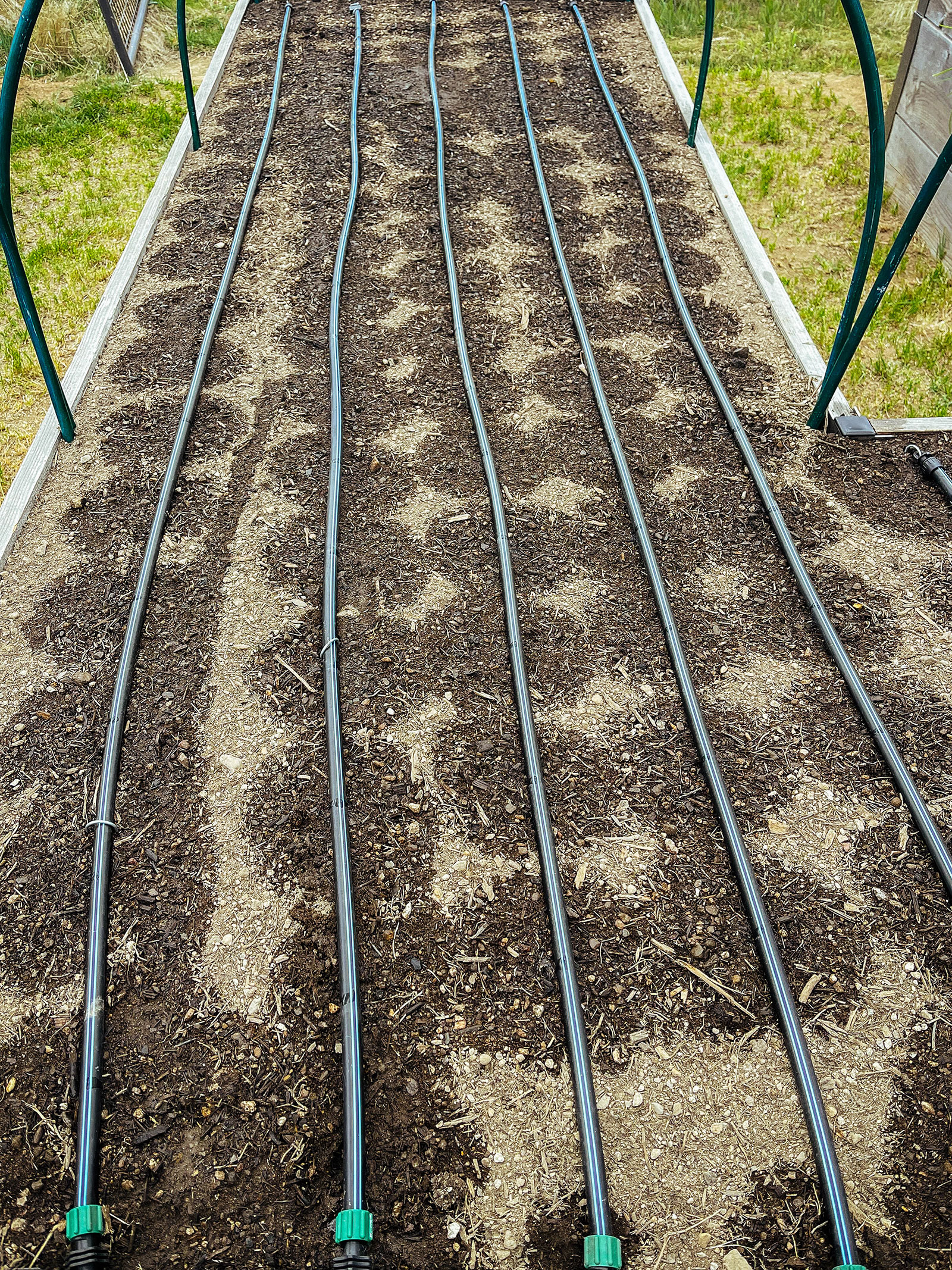
You have 4 driplines in the bed and each line has 12 emitters, so 5 x 12 = 60 emitters.
Each emitter has a flow rate of 1 GPH, so 1 x 60 = 60 GPH.
If you plug those bolded figures into the calculator, you’ll find that you need to run your drip irrigation system for 10 minutes (three times a week).
In the example above, I only calculated the run time for a single 4×8 garden bed, but you can calculate for an entire garden area the same way.
Observe and adjust
Remember what I said earlier about observing and adjusting? The run time is only a jumping off point.
Let’s use the above example where you’re watering seedlings three times a week for 10 minutes each time. As your plants grow larger and their roots go deeper, you might want to switch to watering only once a week for 30 minutes.
Then as the weather gets hotter in summer, your plants may need 2 inches of water each week, which equals 40 minutes of run time. You can deliver that amount in one session or water twice a week.
Shallower-rooted plants (like lettuce) benefit from more frequent watering in shorter bursts, while deeper-rooted plants (like tomatoes) prefer longer durations of watering but less often.
The only way to know if you’re giving your plants enough water is to check the soil after the suggested irrigation run time. Scratch down into the soil and see how moist it is an inch down; that’s the only depth where it starts to count because you can’t tell if you’ve irrigated enough simply by looking at the soil surface.
The next day, dig down and see how much the water has penetrated. If it’s far deeper than the plants’ roots, you can reduce the run time or extend the interval between watering sessions.
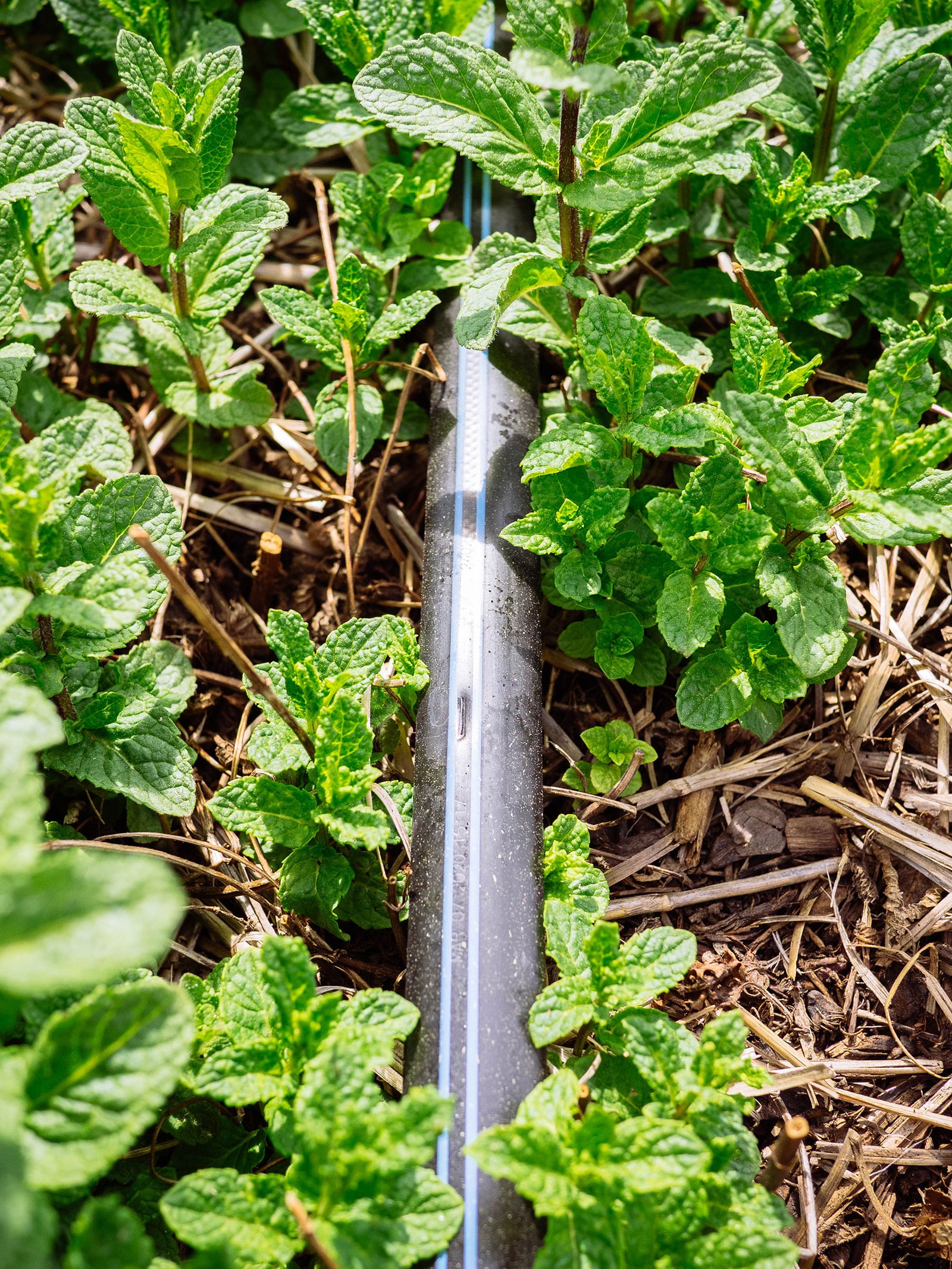
You can also judge your garden’s water needs by paying attention to your plants. Let’s say you want to keep it easy and use my recommendation of 40 minutes as your run time.
After two or three days, do you notice any wilting by late afternoon or evening? Then increase the run time to 50 minutes or decrease the interval (from three days to two days) and see if it makes a difference. Or if the soil surface still looks wet after a couple days, wait to run your drip irrigation again.
I often play around with my irrigation schedule in summer, based on what I’m growing and what the weather’s doing.
For reference, my garden is in a dry, high desert climate in Oregon. I use drip tape in 2-foot-deep raised beds with loamy soil and full southern exposure all day.
In the height of summer, I usually run my drip irrigation on vegetables for about 30 minutes every other day and adjust up or down as needed. As my cucumbers and tomatoes grow bigger, I might set the timer for 45 minutes every three days.
That’s why I suggest starting with a baseline of 40 minutes if you don’t know your flow rates or don’t want to fuss with calculations. Get to know your soil, observe your plants, and remember that irrigation times should change with the seasons.
Quick tip
If you need a guide for determining how much to hand water your garden, use my Plant Watering Calculator.