


Most vegetable and flower seedlings need ample light to develop into healthy, productive plants. Outside, they get this light from the sun. But inside, seedlings need the right light to photosynthesize and grow strong roots.
The “right light” used to mean fluorescent shop lights, then high-output fluorescents, then fancy grow lights that cost a small fortune. But as tech evolves, many of the new LED lights on the market have become very efficient, accessible, and cheap enough to invest in a whole set.

You can definitely spend days geeking out over efficiency, color spectrums, and PAR (photosynthetically active radiation, or the light that drives photosynthesis), especially if you’re a commercial grower who needs to maximize output.
But if you just want to start seedlings indoors, choosing (and using) a good LED grow light doesn’t have to be complicated or expensive at all.
I use the LED lights (below) for seed starting. If you don’t want to read any further, I recommend these LEDs for an indoor seed starting setup because they’re inexpensive, reliable, and check all the boxes I cover below.
Disclosure: If you shop from my article or make a purchase through one of my links, I may receive commissions on some of the products I recommend.
Barrina
Full-spectrum T8 LED grow lights
For casual seed starting, these affordable yet powerful lights will help you raise strong seedlings.
Are they the best grow lights? I’d say they’re one of the best at that price point.
But more importantly, they just work. The lights have great build quality, put out sufficient light, and should last many years. They’re also linkable, meaning you can daisy chain several lights together (and reduce cord clutter).
If you want to keep looking and compare a few options on the market, here’s what you need to know when buying LED grow lights.
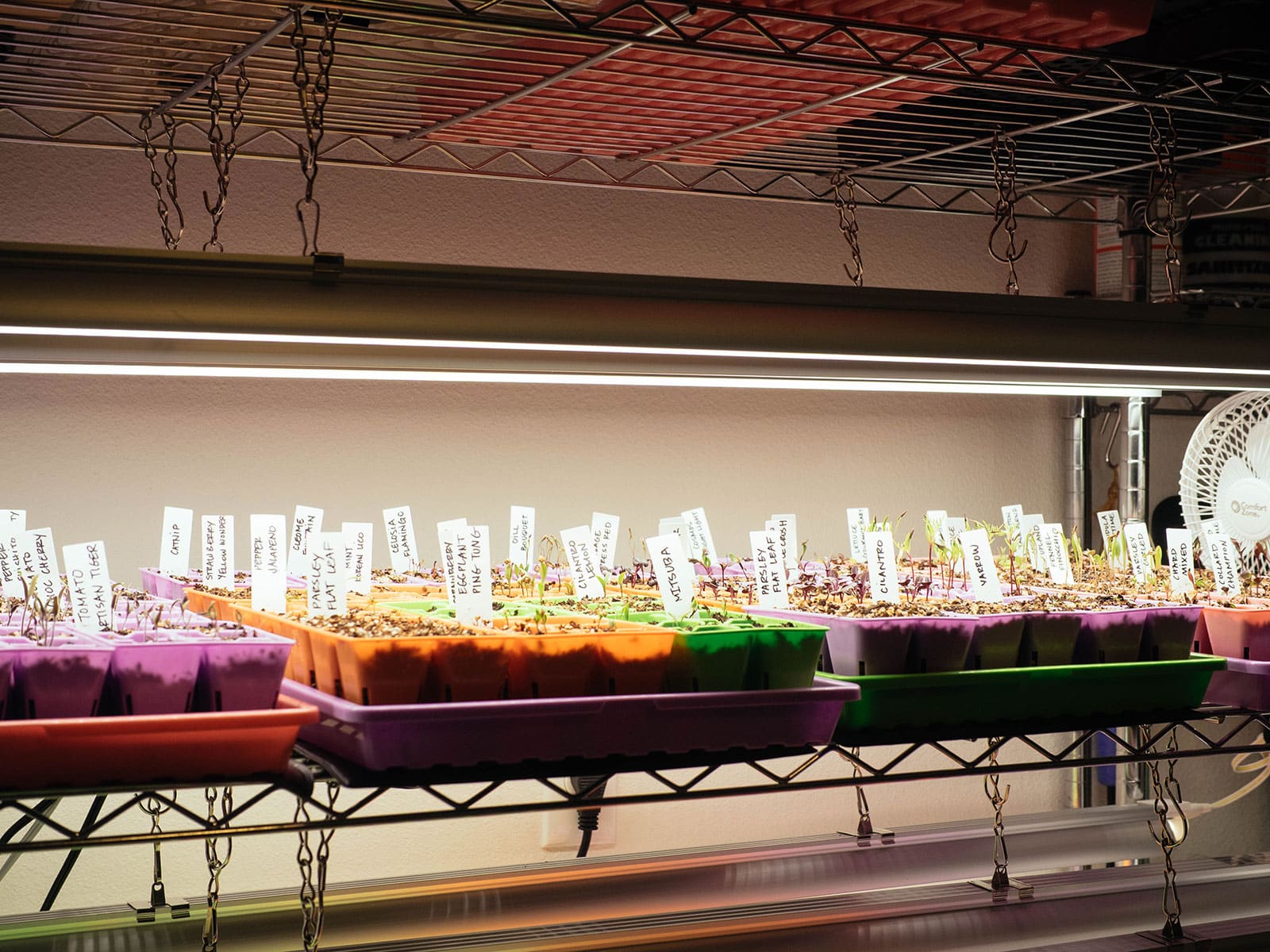
What color spectrum should you use?
Think back to your seventh-grade science class when you watched a beam of light shine through a prism and break into separate spectrums of light. Each color in that rainbow spectrum has its own wavelength, frequency, and energy.
Specific color wavelengths (measured in nanometers, or nm) influence various stages of a plant’s growth cycle. Plants respond to these wavelengths in different ways.
For example:
- Far-red light (700–800 nm) makes plants grow taller and larger
- Red light (600–700 nm) maximizes photosynthesis and overall plant height and triggers photoperiodism (which regulates processes like flowering)
- Green light (500–600 nm) penetrates the plant canopy to support photosynthesis in the lower leaves
- Blue light (400–500 nm) promotes thick leaves and short stems, and triggers chlorophyll production
- UV light (10–400 nm) enhances plant immune responses and other factors like flavor and color
Most plants absorb red and blue light easiest, and these wavelengths are the primary drivers of photosynthesis. In fact, you can grow healthy plants strictly under these two colors of light (using a dual-spectrum or dual-band LED light).
But “blurple” lights, as the blended red and blue spectrums are called, don’t make things easy on the eyes, especially if your seed starting station is inside your home. They sometimes also appear pink, and no one wants to be looking at pink lights all day. (Not to mention anyone walking by a window that has pink lights will probably think drug dealer, ha.)
So for most people, the best color light to get for seed starting is a full-spectrum light. That means it includes all the colors of the rainbow and to the human eye, the light appears pleasantly white.
Full-spectrum lights typically have a Kelvin rating between 5000K and 6500K, which mimics the natural color temperature of daylight.
A full-spectrum LED light over 5000K is ideal for seed starting and easy to live with.
How many watts do you need?
You’ll often find (incorrect) guidance online that gives you a recommended “watts per square foot” rule, or even just tells you to buy the highest watt lights you can find.
However, watts do not equate to the amount of light put out. The watts rating on an LED light refers to how much electricity it’ll use (and thus how much it’ll cost to run the light), but isn’t an indicator of how much brightness it has.
This might seem confusing because with incandescent and fluorescent lights, watts were a good indicator of brightness, as a 60-watt bulb was always brighter than a 25-watt bulb. But that’s not the case for LED, where lower wattage can sometimes produce more light.
What you really want to know is the PPFD (photosynthetic photon flux density) for a given area under the light. PPFD is measured in micromoles of photons per square meter per second (μmol/m²/s).
You can use these PPFD values as a general guide:
- 100–300 μmol/m²/s for seedlings
- 400–600 μmol/m²/s for vegetative growth
- 600–900 μmol/m²/s for flowering
(Note that plants can get damaged with more than 800 μmol/m²/s.)
You’re not likely to find a PPFD value for basic LED shop lights, since they aren’t marketed for gardening. But a reputable manufacturer of LED grow lights will have this information on their website. (If they don’t—likely because they want to sell you on watts—find a different manufacturer.)
For most seedlings, 100 to 300 μmol/m²/s is a safe range for PPFD.
Is PPFD the same as PAR?
No. PAR refers to the spectrum of light (400 to 700 nm) that plants use for photosynthesis. It’s the type of light.
PPFD measures the amount of that light actually hitting the plant canopy per second (μmol/m²/s). It’s the intensity of the light at a specific location.
Many sites think PPFD is the same as PAR, and they might even provide PPFD values but call them PAR values. If an LED light does not advertise PPFD but does mention PAR, you can probably assume they’re the same thing. (Even though they’re not.)
Is PPFD the same as PPF?
No, but they’re related. PPF (photosynthetic photon flux) is the number of photons emitted from a light source within the 400 to 700 nm range. In other words, PPF is the amount of PAR emitted.
While PPFD measures the density of these photons falling on a particular surface, PPF measures the total number of photons released from a single light.
To make things more confusing, some manufacturers may refer to PPF as PAR.
If the manufacturer only lists a PPF value, here’s a simple way to know whether the LED fixture provides enough light:
Seedlings need between 75 and 225 PPF over a 4 feet x 2 feet area.
(That’s the total PPF of all light fixtures above your seedlings, typically two 4-foot light strips or light bars. My suggestion isn’t an exact calculation, since it depends on the hanging distance of your lights, but it should get you close enough.)
How many lights do you need above a tray of seedlings?
I place my 1020 trays with the short ends facing me, so on a 4-foot-wide shelf, I can fit four trays going across.
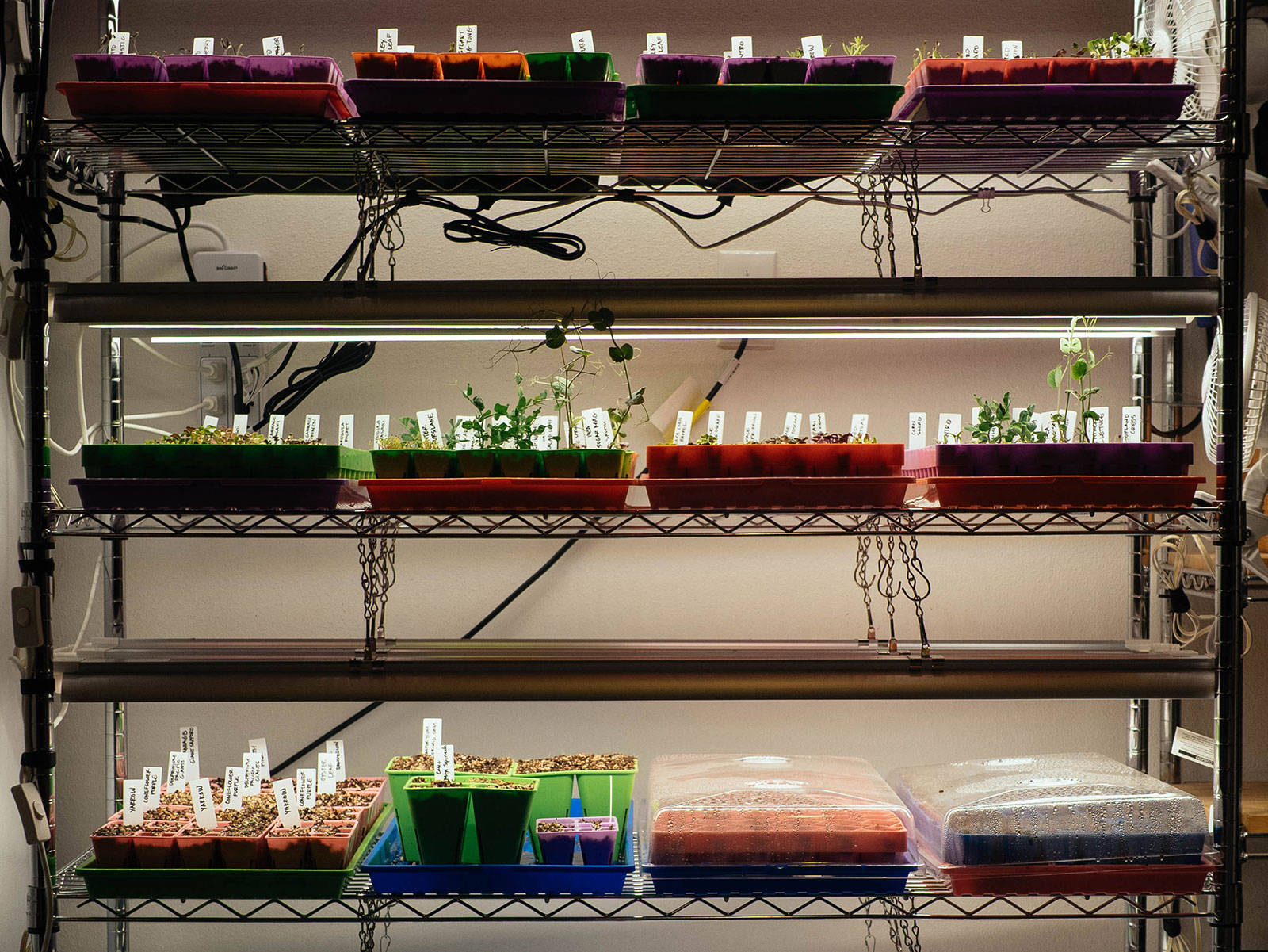
With this setup, I hang two 4-foot light strips under each shelf. This ensures good light coverage on both ends of my trays.
If you orient your trays lengthwise or use other types of trays or containers, you might only need one light bar per shelf. If you have you trays on a deeper table or workbench, you might need to hang three lights above them.
The key is to make sure light hits all your seedlings evenly.
Otherwise, you may find that seedlings in the shadows start to stretch toward the light source.
How far away should you hang your light?
With the fluorescent shop lights of yore, it was common practice to place the lights as close as possible to the seedlings without touching them.
With LED lights, the hanging distance will depend on the PPFD and the number of lights you use above your seed trays. (Check the manufacturer’s website for height recommendations.)
In general, you can hang an LED grow light between 6 and 12 inches above the tops of your seedlings.
Signs of too much light: If seedlings have stunted growth, or the leaves start to turn bleached or yellow (indicating light-induced stress, or “sunburn”), move the light farther away.
Signs of too little light: If seedlings are pale green or stems become weak, thin, and elongated, move the light a little closer.
How long should you leave a grow light on?
Seedlings love a lot more light than most people think. They can sometimes put up with less light, at the risk of slow growth or leggy stems. But if you want to maximize growth:
The standard recommendation is to light your seedlings for 14 to 16 hours a day.
If you’re starting seeds in a dark basement or any other space that doesn’t have much ambient light, aim for the higher end of the range (16 hours). If your seedlings are inside the house where there’s plenty of bright ambient light, they’d probably be fine with just 14 hours.
In my garage setup, I set a timer for 16 hours on and 8 hours off so I don’t have to worry about lighting my seedlings each day. I like this digital timer (below), as it has outlets for all my fans and heat mats as well.
BN-Link
Surge protector digital timer
A multi-outlet timer lets you plug in all your lights, fans, and heat mat while ensuring your seedlings get 16 hours of light per day.
Why can’t you put seedlings near a window?
You can (and I did, when I first started gardening). Most people place a tray of seedlings on a window sill or somewhere near a window and call it good because they still get light.
Unfortunately, sunlight streaming through a window usually isn’t enough because special coatings on modern windows (combined with window orientation and the typical day length in early spring) mean your seedlings aren’t getting the full amount of sun they need to thrive.

Window light can work if you have full southern exposure and transplant your seedlings as soon as they have a few sets of true leaves.
But it’s not ideal for homes with limited natural light or gardeners who have to wait a couple months before they can transplant. So if you’re looking to grow stout, strong seedlings, invest in a decent set of LED lights.
Here are a few more options for good-quality, affordable LED grow lights:
Recommended
Grow lights
Check out my other other guide to see what other items I recommend in an indoor seed starting setup.




This article was very helpful. it broke down all the components of proper lighting in a very “lay person” way, so easy to understand.
Do you have an article on fans; the when, where, how, and why of using fans? I’ve never seen an article that covers that topic in a thorough manner.