
Mealybugs are not only one of the most common plant pests, they’re annoyingly persistent. If you don’t get rid of them all in the first round, they’re likely to come back (sometimes even worse).
But you can control mealybugs! (Organically, too.)
Like spider mites, another common pest, mealybugs are sap-sucking insects, meaning they suck all the sap out of new growth, stem tips, and other aboveground plant parts. Their feeding causes curling, wilting, or yellowing leaves, which then weakens or stunts the plant. If left unchecked, mealybugs can kill your plant altogether.

The insects also excrete trails of clear “honeydew” on the leaves, which is another term for their waste. Honeydew is not only sticky and messy, it promotes the growth of sooty mold and attracts other pests (particularly ants) that love the sugary substance.
Sometimes you’ll see the honeydew before you see the actual mealies, in which case, act fast! Here’s how you get rid of them.
1. Isolate the infested plant
As soon as you see mealybugs, move the infested plant away from your other plants to prevent the pests from spreading. Mealybugs are good crawlers, so inspect nearby plants to make sure they haven’t spread.

2. Treat with rubbing alcohol
If the infestation is small (just a few mealybugs here and there), dip a cotton swab or cotton pad in 70 percent isopropyl rubbing alcohol and wipe off any mealybugs that you see. Pay special attention to the base of the plant where pests may be hiding in nooks and crannies, as well as under the leaves and in leaf junctures.

Mealybugs will turn brown and die on contact because the rubbing alcohol dissolves their waxy, protective coating. Once they change color, you can wipe them off with a towel if any residue remains.
3. Rinse the plant under running water
If the infestation is severe—or you want to make extra sure you got them all—give your plant a thorough shower in the sink, in the bathtub, or outside.
This is the best way to remove lots of mealybugs at once, as you can wash them off with your hands or a strong blast of water, especially around the base and in all the crevices.
4. Inspect the root ball
Check the root ball for signs of soil-dwelling mealybugs. Even if you don’t find any hiding in the roots, you might want to go ahead and wash all the soil off the roots since you’re in there anyway.

This helps remove any cottony egg masses lingering in the soil and it’s helpful for diagnosing other issues you normally don’t see, like smelly or rotting roots. If you find any brown, mushy roots, cut them off with clean scissors before repotting.
5. Repot your plant in fresh potting soil
Scrub the original pot and saucer in hot soapy water (especially under the rim) and repot the plant in fresh potting soil. (Bleaching your pot isn’t necessary.)
Isolate the plant for at least two weeks and keep an eye on it. Mealybugs have a tendency to come back if you miss a few, which brings me to my last tip…
6. Spray as a preventive measure
Your first thought for getting rid of mealybugs may have been to spray them as soon as they appear. But sprays are my last resort because most insecticides work on contact, meaning the solution has to penetrate the mealybugs’ cottony layer. This makes them less effective and more likely to require repeated applications over several weeks.
So, I prefer to use an insecticide or horticultural oil as a preventive measure, applying it to the plant after I’ve used rubbing alcohol, washed off the leaves and soil, and transferred the plant to new potting soil.
This reduces the chance of another mealybug breakout and keeps your plant clean and healthy. You can reapply the insecticide every three to four days during its quarantine, but I don’t recommend repeating the rubbing alcohol treatment more than a couple times; it may damage your plant as much as the mealybugs do.
Disclosure: If you shop from my article or make a purchase through one of my links, I may receive commissions on some of the products I recommend.
Recommended
Insecticides
What To Do If Mealybugs Come Back
Arrgghhh, frustrating. If you’ve tried all these methods and mealybugs keep coming back, I have two recommendations.
1. Bring in the beneficial bugs
If your pest troubles are outside, I’m a big fan of letting nature do its thing. Building up a biological army in your garden is one of the best ways to maintain balance in the ecosystem, and if you don’t have enough good bugs hanging out, the bad bugs will begin to take over.
Natural enemies of mealybugs include hoverflies, lacewings, and ladybugs, which have huge appetites for mealies and many other plant pests. I wrote more about attracting hoverflies naturally, attracting lacewings for biological pest control, and why ladybugs are beneficial to your garden.

You can also attract mealybug destroyer beetles (Cryptolaemus montrouzieri) the same way you attract other beneficial insects. If you purchase mealybug destroyers, make sure they have a reason to stick around and actually do their job before flying off.
(I have more tips for this in my post on how to properly release ladybugs in your yard; the same advice applies to mealybug destroyers.)

2. Use a systemic insecticide
This is an absolute last resort if nothing else works and you’re desperate to get a mealy infestation under control. Yes, a systemic insecticide is a miracle worker, but it’s also extremely toxic and can take a toll on your plants.
For this reason, I DO NOT recommend using systemics on edible plants or flowering plants. (The insecticide doesn’t distinguish between a pest or pollinator.) Follow all directions carefully when applying the systemic and use it away from children and pets.
If and when I need to use a systemic, I let my plant rest in a spot away from direct sunlight for a few days before giving it a shower to remove any remaining mealybug residue.
So, what exactly is a systemic? It’s an insecticide that’s applied to the soil, taken up by the roots, then distributed to the plant tissues. It’s essentially a poison that spreads through the entire plant’s system. When mealybugs (and other insects) feed on the leaves, stems, or flowers, they ingest the poisoned sap and die.
Are you sure it’s a mealybug?
Mealybugs appear as small, soft-bodied, yellowish insects typically covered with a waxy white “fluff” that protects them from moisture loss and excessive heat.
Sometimes this protective coating is so thick that it looks like a web of cotton and you have to look closely to see the mealybugs or egg sacs underneath.

Several species of mealybugs infest indoor and outdoor plants, including the longtailed mealybug (Planococcus longispinus), citrus mealybug (Planococcus citri), and cactus mealybug (Hypogeococcus festerianus and Atrococcus mamillariae, which love to hide in cactus fuzz).


Mealybugs are native to more tropical climates, so naturally, they love warm, moist surroundings and are often found on tropical plants like orchids, palms, hibiscus, and Alocasias.
Related: The most beautiful Alocasia varieties for your home

Sometimes you don’t see mealybugs at all if you’re dealing with a root-feeding species known as ground mealybugs or root mealybugs (Rhizoecus falcifer).
These stealthy pests are commonly found in the potting soil of African violets, cacti, succulents, and other ornamental plants, and they often hitchhike in on greenhouse-grown plants (since they thrive in warm, humid environments).
If you notice a soft, white, cotton-like webbing on the roots, check for ground mealybugs. The fluff sometimes looks like white mold or mycorrhizal fungi, making identification a little tricky. But where you see white fluff, you should also see mealybugs moving around.

Ground mealybugs look similar to their aboveground counterparts: tiny, white, slow-moving insects with a powdery appearance, nestled in the root mass or in the pot’s interior.
Sometimes other mealybug species will move to the roots when a plant is dormant or stressed, but return to the stems and leaves once the plant is actively growing again.
Mealybug lookalikes
Since mealybugs are a type of scale insect, they’re often confused for other soft scale insects, such as the cottony cushion scale (Icerya purchasi) and cottony camellia scale (Pulvinaria floccifera).


Woolly aphids are frequently mistaken for mealybugs because of the white, waxy, cotton-like filaments that protect their soft bodies. (You’ll know it’s a woolly aphid if it flies away when you disturb it.)
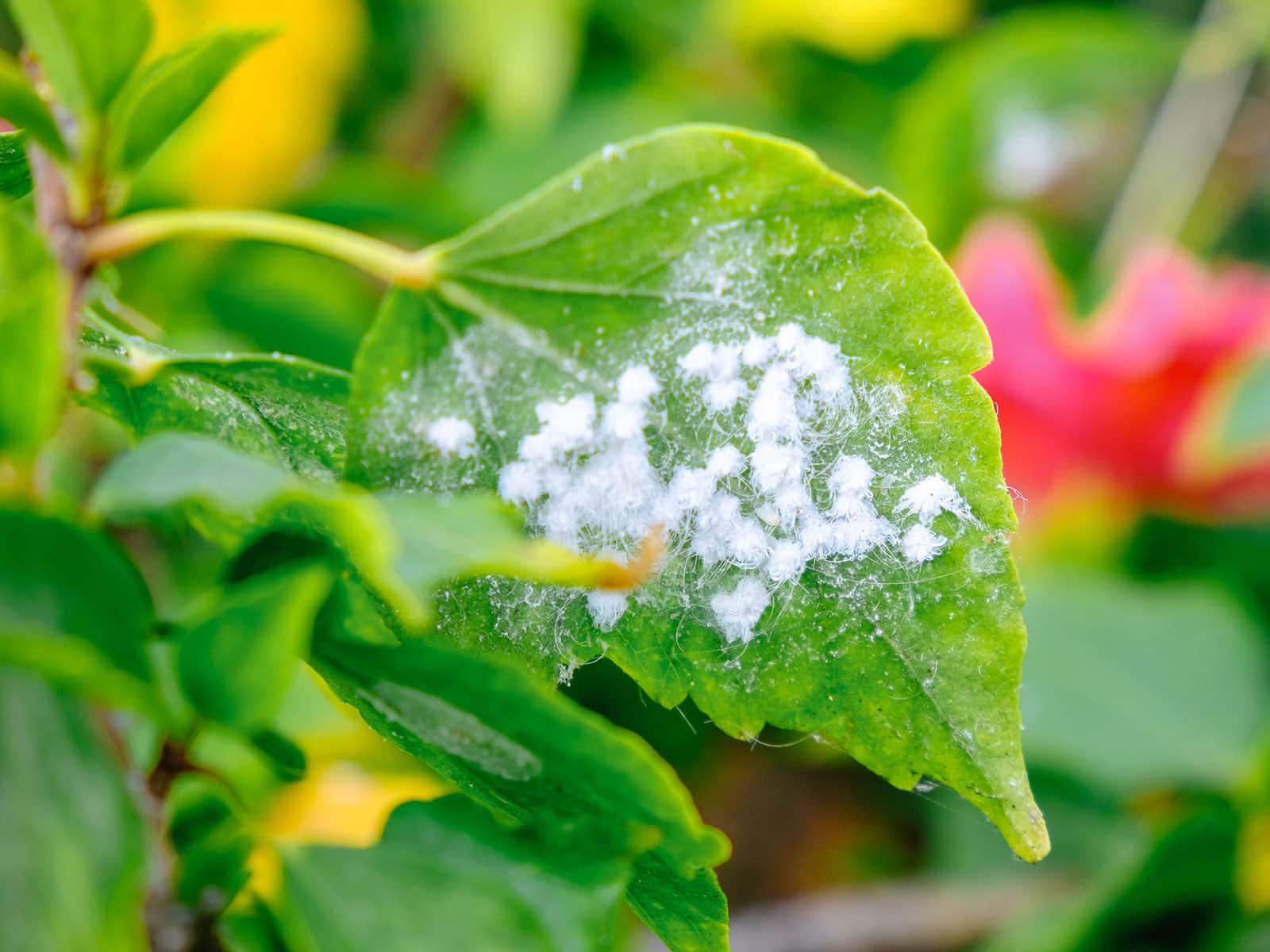
Mealybugs even resemble their own predator, the mealybug destroyer (Cryptolaemus montrouzieri, a beetle whose larvae mimic the mealybugs’ white fluffy coat).