


Of all the ornamental plants you can grow indoors, Alocasias are among my favorite. Maybe it’s because I live in Central Oregon where winter seems to last half the year, but the striking foliage on these head-turning plants never fail to make my home feel like a tropical hideaway.
Alocasia is a genus of broad-leaved perennial flowering plants from the family Araceae (otherwise known as the aroids), containing about 90 accepted species that are native to tropical and subtropical Asia and Eastern Australia. Many more varieties of Alocasia exist through hybridization.
Read more: A regular person’s guide to understanding plant taxonomy
They range wildly in size, from species that stay compact at just 1 to 2 feet, to plants that grow over 12 feet tall with leaves spanning 3 feet in length.
For the casual plant lover, however, the majority of Alocasias sold in plant shops and garden centers are on the smaller side—a special subgroup of tropical aroids known as Jewel Alocasias—making them more manageable as houseplants. And “jewel” is quite a fitting name, as they include the jewels of the modern houseplant boom, such as Alocasia amazonica ‘Polly,’ Alocasia baginda ‘Dragon Scale,’ and Alocasia rugosa ‘Melo.’
The Jewel Alocasias are remarkable rainforest specimens with unique leaf textures, shapes, and variegation. You may have heard of them referred to as elephant ears, a common name given to several species of similar-looking plants with large, heart-shaped leaves belonging to the genera Alocasia, Colocasia, and Xanthosoma.
Alocasias are the plants you’ll typically find growing indoors. They’re better known as upright elephant ears, since the leaves in each new clump grow vertically—that is, higher than the previous clump, while staying nearly the same width—rather than horizontally like most other tropical species.
Unless you’re lucky enough to live somewhere with an amazing specialty plant shop, the best place to buy Alocasias (especially Alocasia varieties that are less commonly available) is online, and I’ve linked to my favorite sources below.
Disclosure: If you shop from my article or make a purchase through one of my links, I may receive commissions on some of the products I recommend.
Where to buy
Best types of Alocasias
While they’re not the easiest indoor plants to keep alive (compared to say, Chinese evergreens, wandering Jew, spider plants, or hoyas, which are among my top picks for beginners), Alocasias are very much worth the effort if you love a tropical jungle vibe in your home. (Don’t worry, I’ve got you: down below, you’ll find my best tips on caring for your Alocasia.)
But first, here are my favorite Alocasia varieties, rare and common (with species names, common names, and pictures). Most are compact Jewel Alocasias, but a few true giants made the list too, so check the mature size before you bring one home.
1. Alocasia amazonica ‘Polly’
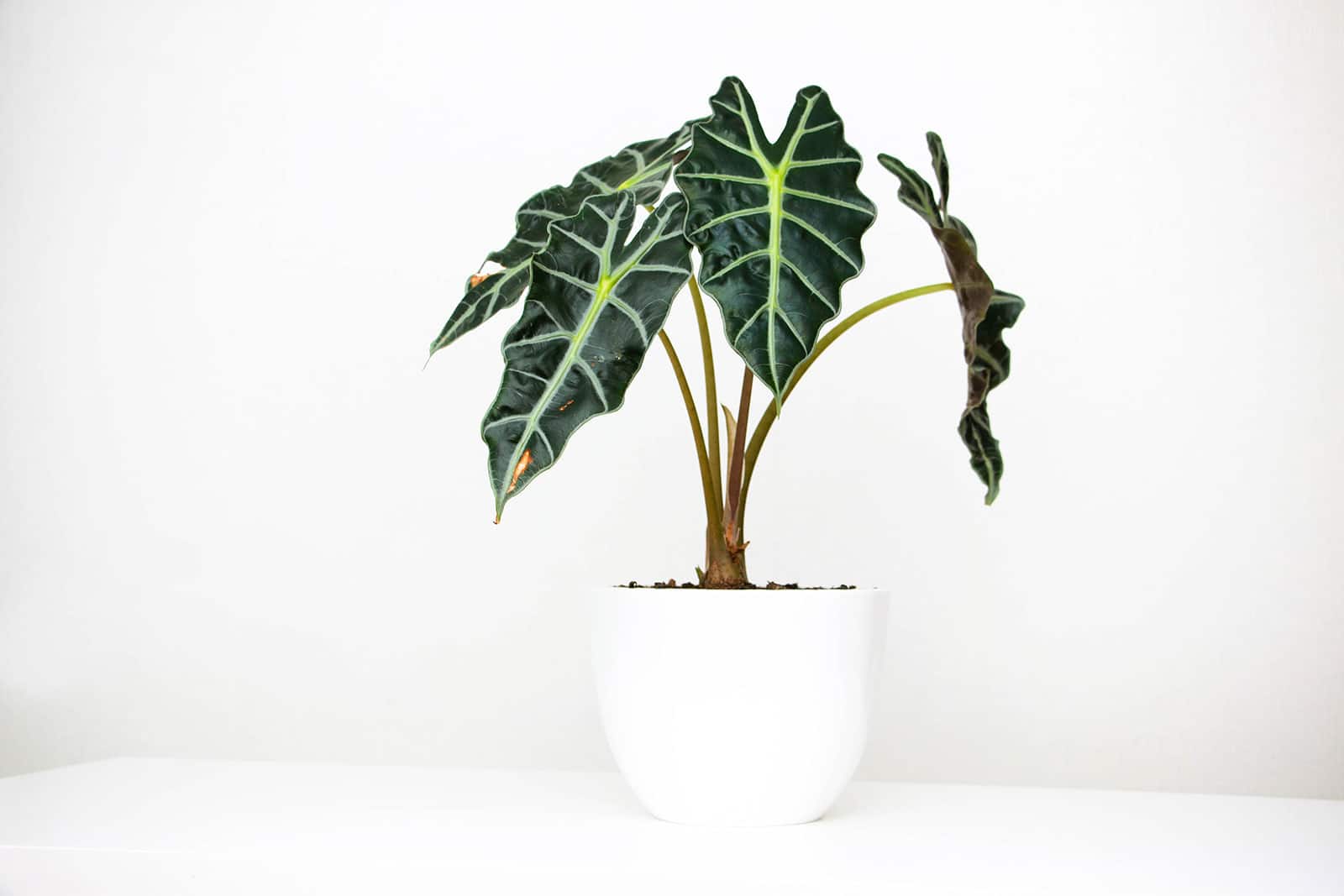
By far, ‘Polly’ is the most popular and readily available Alocasia variety (at least in the United States). Also known as the African Mask plant, it’s a compact form of Alocasia x amazonica, the hybrid of Alocasia watsoniana and Alocasia sanderiana that Florida grower Salvadore Mauro bred in the 1950s and named after his now-defunct Amazon Nursery. ‘Polly’ came along decades later, as a smaller mutation spotted among Amazonica plants at another Florida nursery, Silver Krome Gardens.
Alocasia ‘Polly’ has slender, dark green leaves with wavy, undulating edges and thick white veins running through them. It’s a fairly compact plant, growing no more than 18 to 24 inches in height and 10 inches in width, with leaves reaching up to 16 inches long.
2. Alocasia amazonica ‘Bambino’

Even smaller than ‘Polly’ is ‘Bambino,’ a dwarf variety of the already compact Alocasia x amazonica. Alocasia ‘Bambino’ has deep green, arrowhead leaves with silvery green veins and purple undersides.
The plant grows up to 12 inches in height and width, with leaves that generally span 6 inches long and 2 inches broad. It’s the perfect plant for small spaces!
3. Alocasia sanderiana

Meet one of the parents. Alocasia sanderiana is half of the cross that gave us Alocasia x amazonica, so if it reminds you of ‘Polly’ and ‘Bambino,’ that’s why. It’s known as the Kris plant because its scalloped leaf edges resemble the wavy blade of a kris, a traditional Southeast Asian dagger. The glossy, arrow-shaped leaves are deeply lobed and nearly black-green, outlined in bold silvery-white veins and margins.
In the wild, this species grows only in Northern Mindanao in the Philippines, where it’s critically endangered (and collecting it from the forest is illegal). Every plant in the houseplant trade should come from a nursery, so buy from a source you trust.
Indoors, Alocasia sanderiana usually grows 2 to 3 feet tall, with leaves 12 to 16 inches long.
4. Alocasia micholitziana ‘Frydek’

Alocasia micholitziana ‘Frydek,’ commonly called Green Velvet Alocasia, resembles Alocasia ‘Polly’ in its general size and leaf appearance, but is a little harder to find commercially. The plants have velvety (as opposed to glossy) dark green leaves with wavy edges and glowing white veins.
This medium-sized variety (as far as Alocasia plants go) grows 2 to 3 feet tall when mature and is slightly narrower than it is tall. The leaves average 18 inches long when fully grown.
5. Alocasia reginula ‘Black Velvet’
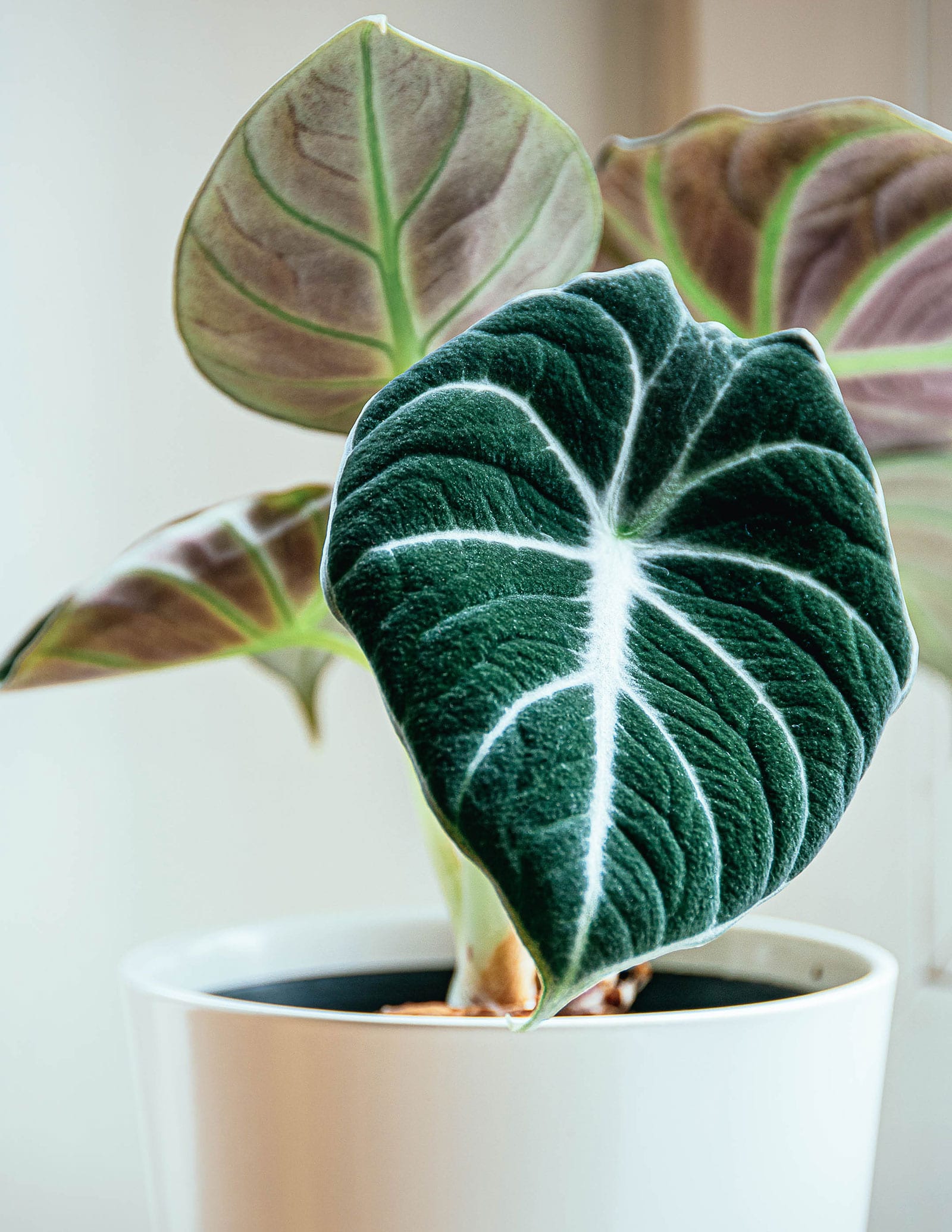
If you’re looking for a darker and more mysterious plant, Black Velvet Alocasia (also known as Little Queen) is right up your alley. The foliage develops a rich, almost-black color with silvery white veins, and has sort of a velvety texture. The heart-shaped leaves are thicker than most Alocasias and nearly succulent-like.
Black Velvet Alocasia grows to about 12 inches tall and 18 inches wide, giving it a bushier appearance than other Alocasia types.
6. Alocasia ‘Venom’

If ‘Black Velvet’ is moody, ‘Venom’ is downright menacing. This newer cultivar is a mutation of Alocasia x amazonica, discovered by Mason Lee of Mason Plants in South Korea around 2019 and sold commercially since 2022. Lee named it after the Marvel villain, and one look explains why: long, narrow, sharply pointed leaves in a green so dark it reads black, with raised silvery-white veins and wavy, serrated edges.
‘Venom’ stays compact at about 2 feet tall indoors. It’s still one of the pricier Alocasias you can buy (expect to pay $75 or more for a small plant), so for now, it’s a collector’s splurge.
7. Alocasia ‘Regal Shields’

Remember ‘Black Velvet’ (#5)? Cross it with Alocasia odora and you get ‘Regal Shields,’ a hybrid bred by LariAnn Garner of Aroidia Research. It takes its dramatic coloring from ‘Black Velvet’ and its upright habit from odora. The broad, shield-shaped leaves are glossy dark green suffused with purple on top and deep purple underneath, etched on both sides with bold, light green veins.
It’s also a friendlier plant than its velvety parent: easier to grow and less sensitive to cold than ‘Black Velvet,’ with thicker, sturdier leaves than odora. (If ‘Black Velvet’ has ever sulked on you, this is the forgiving cousin.)
‘Regal Shields’ stays fairly compact indoors, usually 1 to 3 feet tall.
8. Alocasia rugosa ‘Melo’

This Jewel Alocasia has the thickest and most deeply ridged leaves, to the point where you might mistake it for an artificial plant! The rough-textured, jade green to greenish-black leaves (which look and feel almost like cardboard) have prominent, intricate veins.
With a dramatic, shrub-like shape, Alocasia ‘Melo’ grows 1 to 2 feet tall with leaves spanning up to 20 inches long and 10 inches wide.
9. Alocasia maharani ‘Grey Dragon’

If you’re thinking ‘Grey Dragon’ looks quite similar to ‘Melo,’ you’re right—it’s a hybrid of Alocasia rugosa ‘Melo’ and Alocasia reginula. Its foliage is a muted, silvery deep green.
Compared to other plants in the genus, ‘Grey Dragon’ is somewhat dwarf in size. It rarely grows taller than 14 inches and its leaves span up to 6 inches long.
10. Alocasia baginda ‘Dragon Scale’
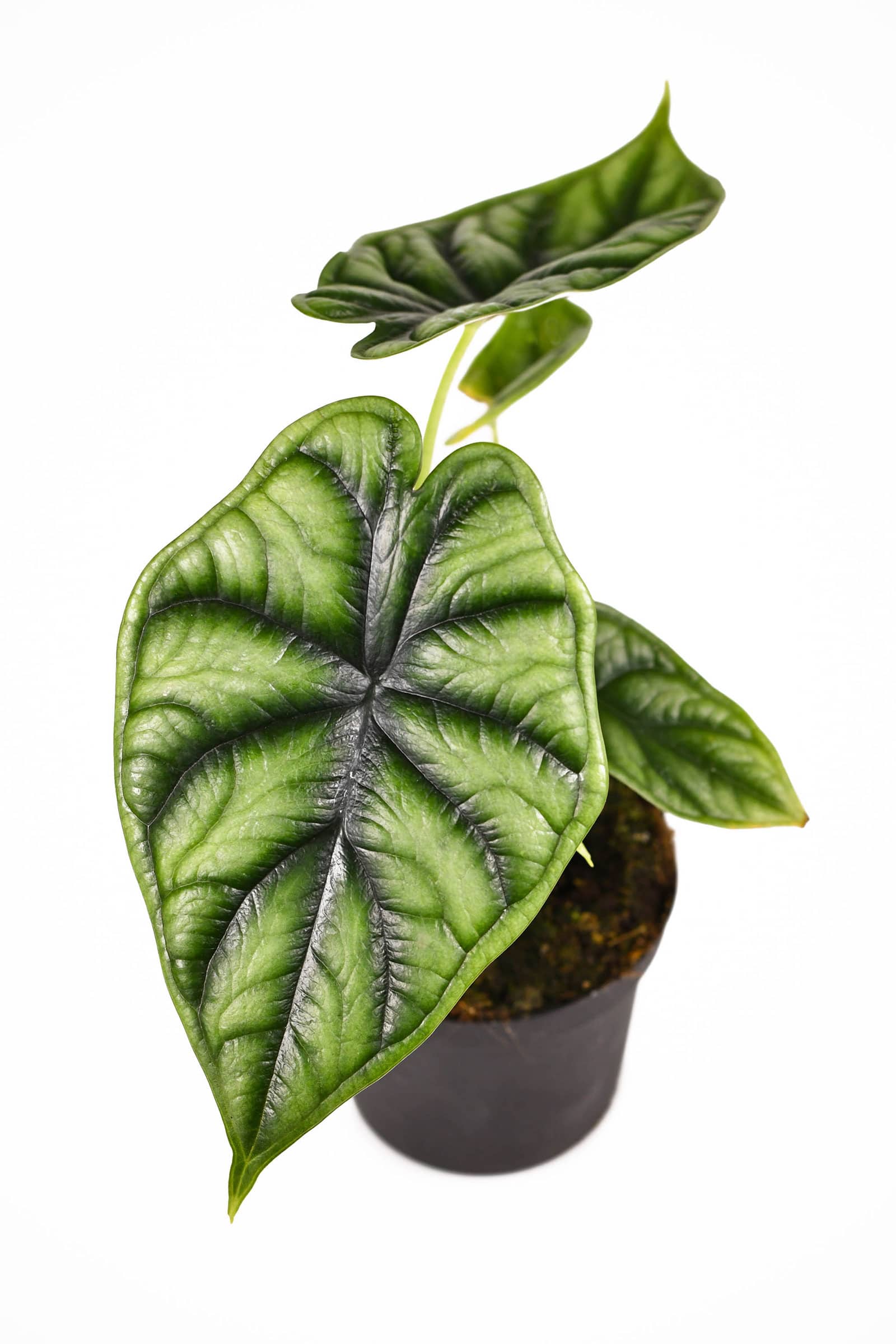
As one of the most stunning Jewel Alocasia varieties, ‘Dragon Scale’ boasts spectacular, silvery green leaves with deep green primary and secondary veins that resemble large scales (and are also slightly hardened like scales). The undersides, meanwhile, are cream with bold burgundy veins.
Alocasia baginda ‘Dragon Scale’ grows up to 3 feet in height and about half that size in width.
11. Alocasia baginda ‘Silver Dragon’

This cultivar is highly sought after for its unusual and exquisite foliage. Similar to ‘Dragon Scale,’ Alocasia baginda ‘Silver Dragon’ features pale, silvery blue leaves with primary and secondary veins that are sage green to dark green in color.
It’s a fairly compact plant that rarely reaches more than 3 feet in height and width, and even fully grown leaves stay small at about 6 inches in length.
12. Alocasia zebrina

This unique Alocasia sports the characteristic shield-shaped foliage of the rest of the genus, but without the distinctive white veins that run through the leaves. One look at Alocasia zebrina and you can guess how it got its name: its petioles are adorned with black and yellow markings reminiscent of zebra print.
Alocasia zebrina grows to a maximum height and width of about 3 feet.
13. Alocasia zebrina ‘Reticulata’

‘Reticulata’ is a cultivar of Alocasia zebrina, which means it bears the distinctive zebra print-like pattern on its petioles. What makes it different, however, is its equally distinctive leaf reticulation (an interlacing pattern resembling a net) that you won’t find on other Alocasia plants.
This unusual variety reaches up to 3 feet in height and about the same size in width.
14. Alocasia macrorrhiza ‘Stingray’ and ‘Baby Ray’

This Alocasia is unique in that it shares the same zebra-esque markings of Alocasia zebrina, but with a completely different leaf shape. The rounder, ribbed leaves point upward and outward with a long, whip-like tail at the terminal end, resembling a stingray with its “wings” and sharp tail.
Alocasia macrorrhiza ‘Stingray’ typically reaches 3 to 5 feet in height, but ‘Baby Ray’ (a dwarf strain of ‘Stingray’) maxes out at 2 to 3 feet tall.
15. Alocasia cuprea ‘Red Secret’
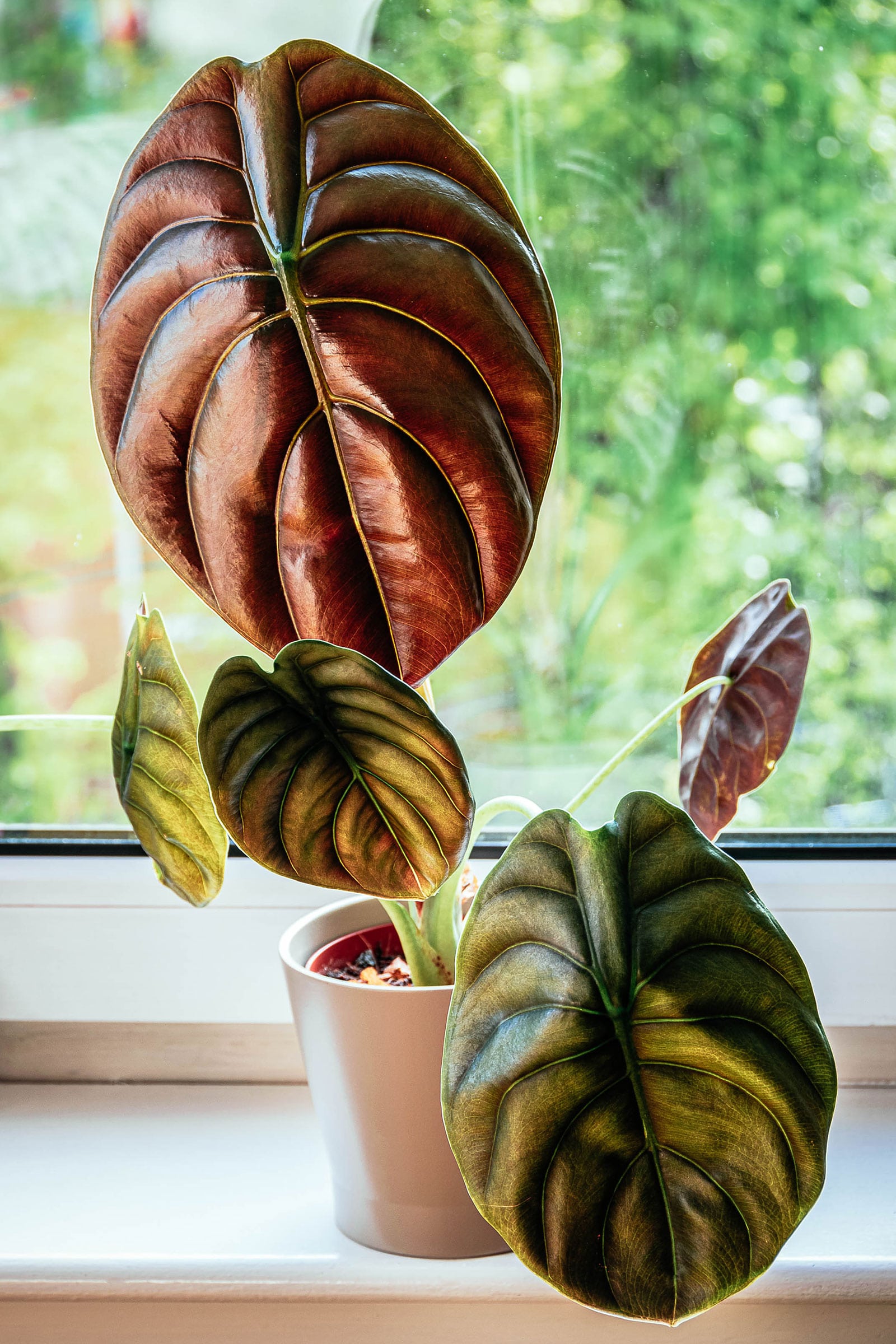
This cultivar is a standout among Alocasias with its striking reddish-pink foliage. Young leaves emerge as coppery green with a pink sheen, and over time develop into a more saturated deep green while retaining that signature pink opalescence. The veins are so dark that they almost appear black.
Alocasia cuprea ‘Red Secret’ reaches up to 3 feet in height and width, with leaves spanning 12 to 18 inches in length.
16. Alocasia ‘Pink Dragon’

Don’t let the name fool you: ‘Pink Dragon’ isn’t one of the baginda “dragons” like ‘Dragon Scale’ and ‘Silver Dragon.’ It’s a natural hybrid that turned up at a flower market in Bangkok and was first sold in the US as Alocasia ‘Aurora.’ It didn’t catch on here, but once it was renamed ‘Pink Dragon’ in Europe, it took off. (Never underestimate a good rebrand!)
The draw is the stems: saturated pink petioles holding up glossy, dark green, arrow-shaped leaves with pale silvery veins. Nobody knows its exact parentage, so you’ll see it labeled half a dozen different ways, including as a baginda or a calidora hybrid.
In a pot, ‘Pink Dragon’ grows 2 to 3 feet tall.
17. Alocasia macrorrhizos ‘Giant Taro’
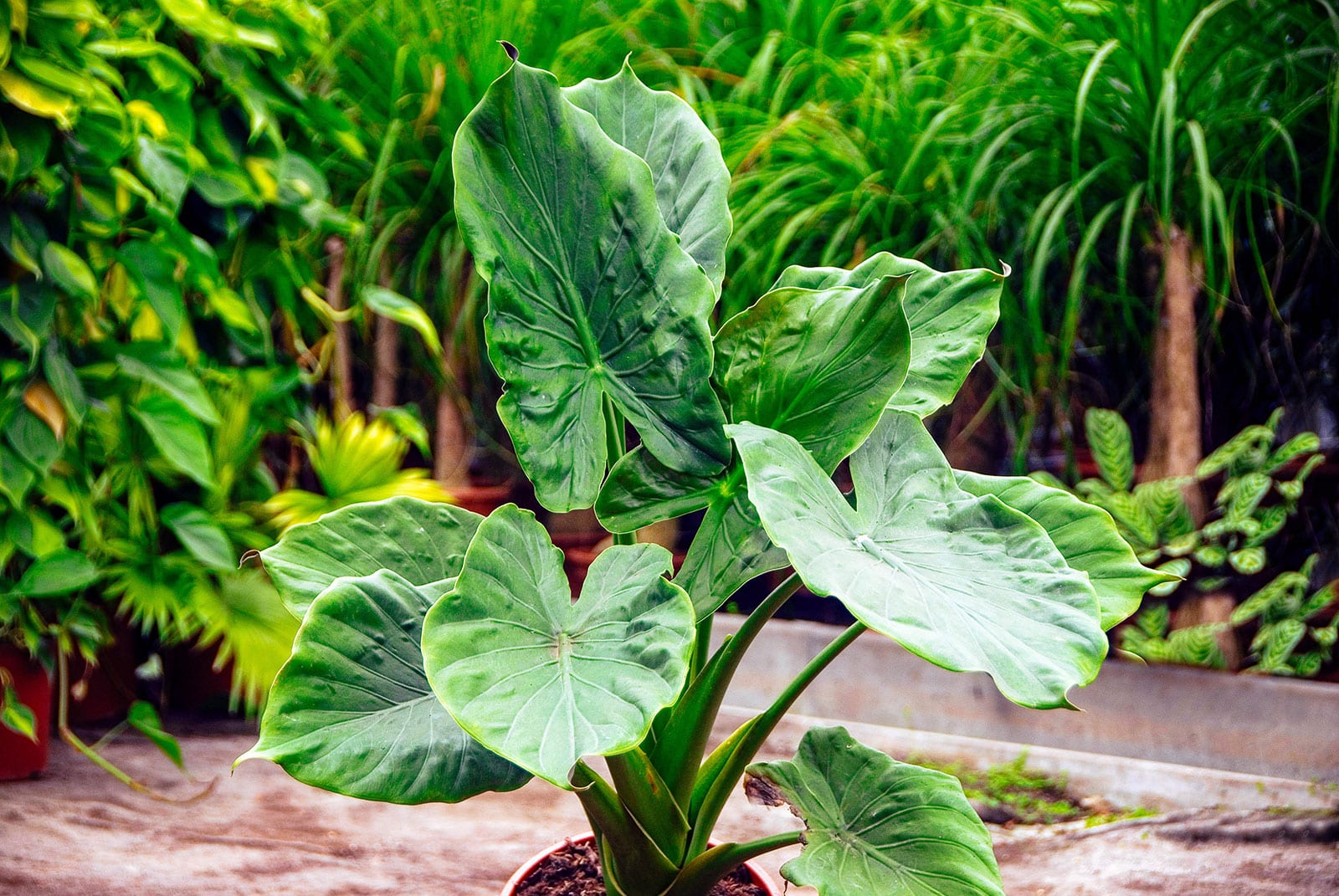
Alocasia macrorrhizos is no jewel—it’s one of the largest Alocasias you can grow, which is how it earned the common name giant taro (not to be confused with Colocasia, the taro grown for its edible corms).
As a houseplant contained in a large pot, ‘Giant Taro’ grows up to 6 feet tall and 3 to 5 feet wide, with leaves spanning 3 feet long.
18. Alocasia longiloba

This cultivar is known for its narrow and dramatic shield-shaped foliage. The topside of the leaves are bluish-green with silvery white blade margins and primary veins, while the underside is a striking deep purple hue.
Alocasia longiloba stays relatively compact with a height and width maxing out at 1 to 3 feet, but with large leaves that span 2 to 3 feet long and 12 to 15 inches wide.
19. Alocasia wentii

Alocasia wentii is noted for its large, deep green foliage with surprising purple-bronze undersides. The leaves have an elongated heart shape that draws into a point to create what’s known as a “drip tip,” which allows water to neatly drop off the leaf.
This variety reaches 3 to 4 feet tall when fully grown, with huge leaves spanning up to 3 feet long to form a dramatic canopy.
20. Alocasia lauterbachiana ‘Purple Sword’

It’s easy to see where Alocasia lauterbachiana ‘Purple Sword’ gets its name from: the long, narrow leaves with their scalloped edges have a striking sword-like appearance. While the top side is glossy green, the underside is a contrasting coppery purple hue.
Mature plants grow up to 4 feet tall and 3 to 4 feet wide. The leaves, which are longer and narrower than other Alocasia varieties, reach 2 feet long but only 2 inches wide.
21. Alocasia macrorrhizos ‘Plumbea Nigra’

Most of the plants on this list fit on a shelf. This one needs a corner. Often sold as Alocasia plumbea ‘Nigra’ or black metallic taro, it’s a bold, upright elephant ear with metallic leaves so dark green they look black, held on sturdy purple stems. Flip a leaf over and the underside flashes silvery purple. ‘Plumbea’ is one of the oldest known cultivars of giant taro, with botanical illustrations dating back to 1857.
It also has a famously weird offspring: Alocasia ‘Flying Squid,’ a dwarf mutation of ‘Plumbea’ whose leaves have shrunk to pencil-thin, tentacle-like stalks with tiny pointed tips. (You might also see it sold as ‘Mythic Tentacular.’) It tops out around 12 inches tall—about as far from its parent as a plant can get.
‘Plumbea Nigra’ grows 3 to 5 feet tall with leaves 12 to 24 inches long. It’s also sold as a summer bulb, so if you have a shady patio, it can spend the warm months outside in a big container and come back in before your first frost.
22. Alocasia portei
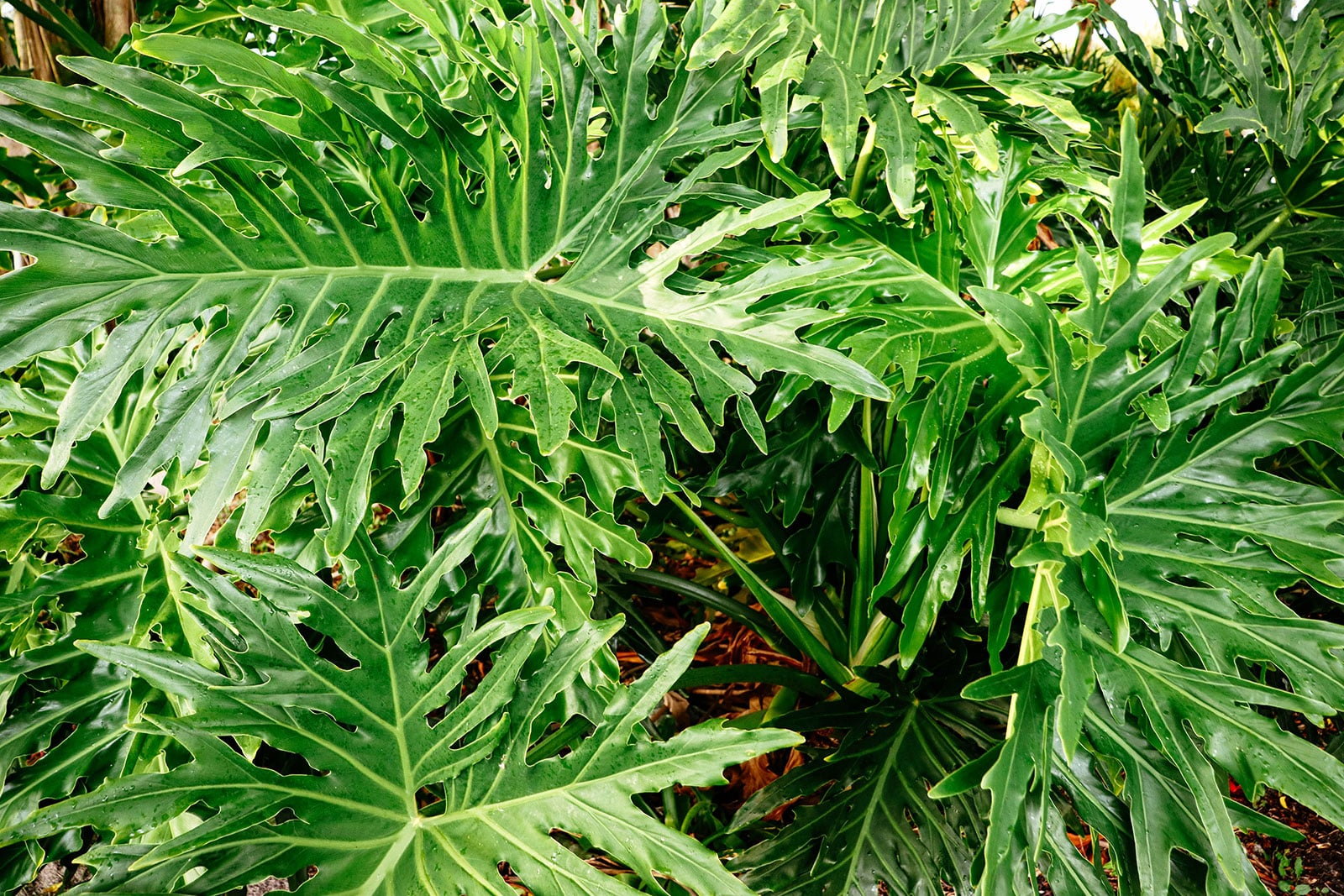
Also known as the Malaysian Monster, Alocasia portei is truly a showstopper with some of the most dramatic foliage of all the Alocasias. The large-growing species features distinctive, deeply lobed leaves that remind me of arugula—a giant, tropical arugula!
When fully grown, Alocasia portei reaches 5 to 8 feet in height with enormous leaves spanning 3 to 4 feet in length.
23. Alocasia tandurusa ‘Jacklyn’

Last but certainly not least is the newest species on this list. Collectors grew and traded ‘Jacklyn’ for years before botanists formally described it in 2023 as Alocasia tandurusa, native to northern Sulawesi in Indonesia.
The name comes from tanduk rusa, Indonesian for “deer antler,” which is exactly what the leaves look like: bright green blades cut into deep lobes, traced with dark veins, and held on mottled brown stems. They’re rough to the touch, too, which is unusual for an Alocasia. (‘Jacklyn’ itself is a misspelling of Enjie Jacklin, the Sulawesi local who first popularized the plant online.)
Indoors, Alocasia tandurusa can reach about 4 feet tall and wide.
Quick care guide
Most Alocasias have similar needs and care instructions since they’re closely related. However, it’s always a good idea to double-check how to care for your new plant when you bring it home to make sure it thrives. Here are a few tips for growing Alocasia indoors and keeping it happy.
Light
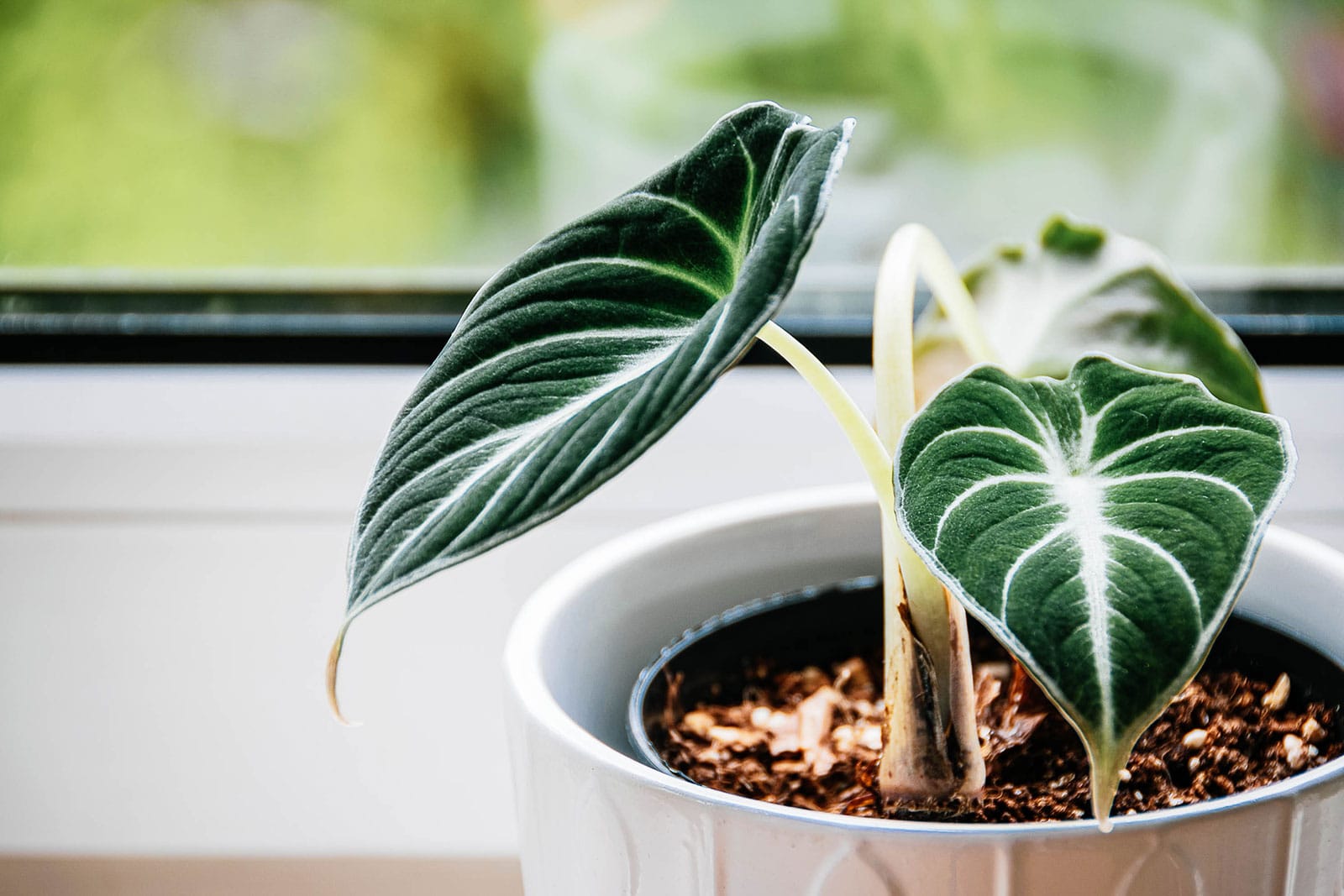
Alocasia plants prefer bright, dappled light. Since they’re naturally found in the tropics and subtropics under a canopy of trees, try to mimic this environment at home and keep them away from harsh, direct sun. In the Northern Hemisphere, an east-facing window is most ideal, or you can put them near (but not right in front of) a south-facing window.
Temperature
As heat-loving plants, Alocasias do best in a warm home that stays between 65°F and 80°F. Try not to let the temperature drop too much below 60°F, otherwise some Alocasia plants may go dormant and drop all their leaves. Avoid placing them near drafty doors or single-paned windows.
Humidity
Alocasias need plenty of humidity—at least 50 percent—to be happy. This is one reason the plants have earned their reputation as divas, as they don’t do well in dry environments. Be careful placing your Alocasia too close to a heat source (like a vent or fireplace) as this can dry out the air too much.
To increase humidity without a humidifier, you can keep your plant in a bathroom or kitchen (which tend to be the most humid rooms in the house), or group several plants together to create your own mini jungle paradise.
Watering
It’s no surprise that Alocasias like moisture, but how much and how often to water will depend on the amount of sunlight they get and how humid their environment is.
In summer, water your Alocasia plant once or twice a week. In winter, when growth slows down, water when the top 1 to 2 inches of soil feels dry. This may happen every 7 to 10 days, but don’t let the soil go bone dry during the cooler months.
A couple times a year, give your plant a refreshing shower in the sink or bathtub to cleanse the leaves of any dust, dirt, dander, and other particles.
Soil
Alocasias don’t like standing water, so make sure your plants are potted in loose, well-draining soil. The best “soil” for your Alocasia is actually a soilless potting mix, and you can make a good, basic potting medium by mixing sphagnum moss, bark, and perlite in equal quantities.
Recommended
Soil ingredients
You can also buy specialty aroid soil, which is ideal for not only Alocasias, but also Monsteras, Rhaphidophoras, Philodendrons, and orchids.
Fertilizer
When it comes to fertilizer, Alocasias are thankfully pretty low-maintenance. Even during peak growing periods, they don’t demand much in terms of plant food. You can apply a monthly application of diluted liquid houseplant fertilizer in spring, summer, and fall. There’s no need to fertilize in winter when the plants aren’t actively growing.
Recommended
Fertilizers
Pests
Dry indoor air invites spider mites, one of the most common pests on Alocasias. Check the undersides of the leaves for fine webbing and tiny pale speckles, especially in winter when the heat is running. Mealybugs show up now and then too, as cottony white clusters tucked where the leaf stalks meet the base of the plant.
Here’s how to get rid of spider mites and deal with mealybugs.
Frequently asked questions
This post updated from an article that originally appeared on January 15, 2022.





Hello Linda Ly, my name is Barbara Rowell. I’ve developed an interest in growing plants over the last 10 years or so and now I have a neighbor who gives me all the plants she’s not having much luck with, so I can try my hand with them. I’m getting some varieties that are new to me and have the PlantNet app to help me; however, I wondered if you have the time to look at a pic of some Alocasias (I think) that she gave me and confirm the speciation for me? Thanks, and will send a pic, if I hear back from you (and I’m filing this website in my “Garden” folder (loved it)!!!