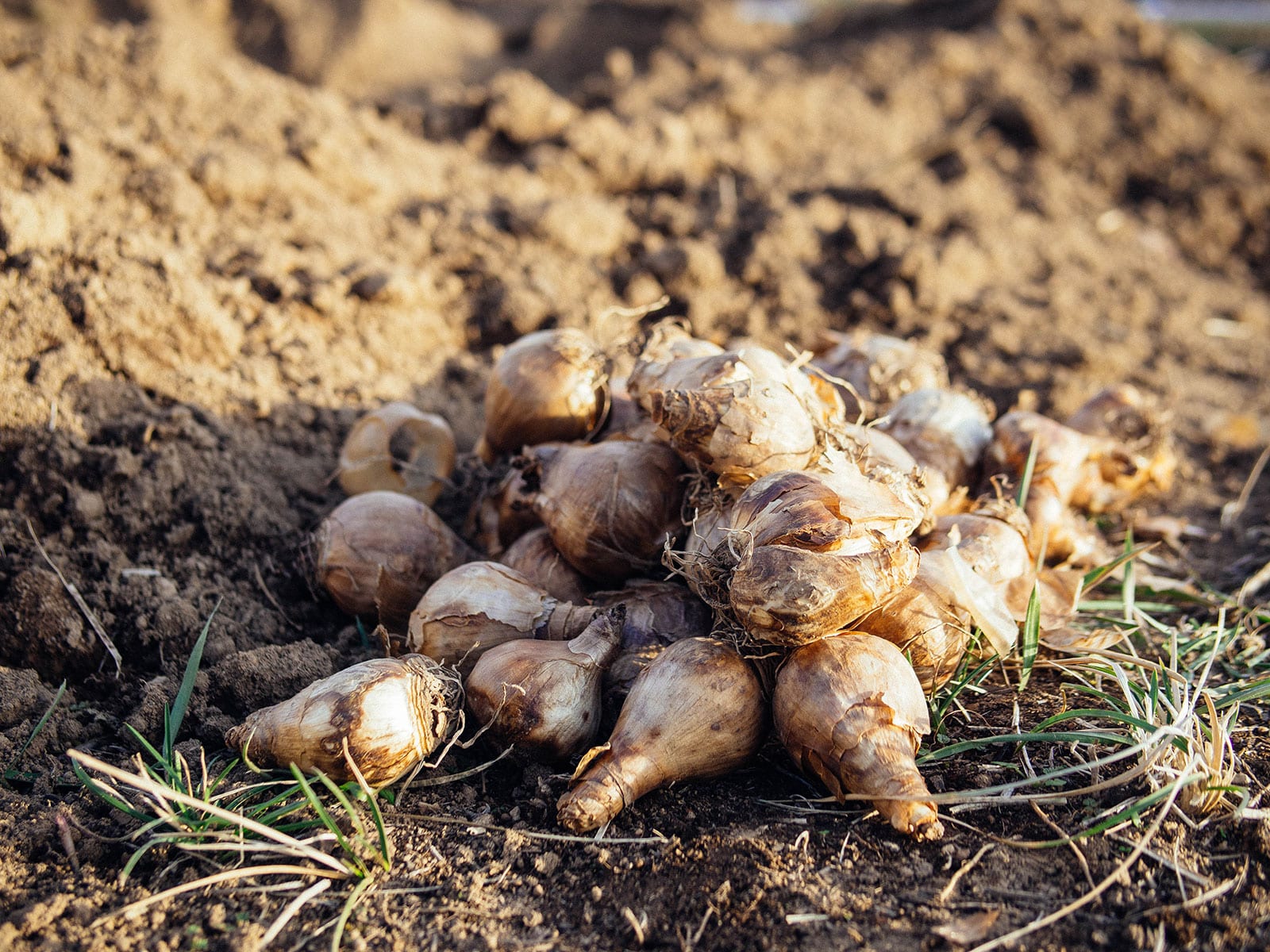
Raise your hand if you bought a bag of tulip bulbs back in September (maybe two bags, because they were on sale and you were feeling ambitious), set them on a shelf in the garage, and haven’t thought about them since.
No judgment here. Fall fills up fast with the last tomato harvest, the leaf raking, the garlic planting, and the sudden realization that the hose is still attached to the spigot. Bulbs are patient. They don’t wilt, they don’t complain, and they don’t remind you they exist. That’s exactly how they get forgotten.
The good news: you probably haven’t missed your window. Spring-blooming bulbs are some of the most forgiving things you can plant, and the real deadline has less to do with the calendar than with what’s happening a few inches below your feet.
In my zone 5 microclimate, I’ve even planted bulbs as late as Christmas (whoops) but they bloomed beautifully by April, and I’ll explain how and why that worked.
Disclosure: If you shop from my article or make a purchase through one of my links, I may receive commissions on some of the products I recommend.
How late can spring-blooming bulbs be planted?
In short: as long as you can still dig a hole.
Tulips, daffodils, crocuses, hyacinths, and most other spring-blooming bulbs are typically planted from late September through early November, before the ground freezes. Where you land in that range depends on your USDA hardiness zone. (Check your zone with my lookup tool if you aren’t sure what yours is.)

Northern gardens (zones 3 to 5) sit on the early end, gardens in zones 6 and 7 can often go well into November, and in the warm southern zones, “fall planting” stretches into December and even January.
But here’s the important thing: Soil temperature is a much better signal than the calendar. Bulbs are happiest going in once the soil 6 inches down drops below 60°F, which usually lines up with nighttime lows in the 40s. (I use the soil thermometer below to check.)
Urban Worm
Soil thermometer
This simple, stainless steel soil thermometer has a 5-inch stem and easy-to-read face that helps you determine when your soil is ideal for sowing or planting.
Those windows aren’t fixed, either. A warm, dry autumn can keep the ground open for weeks past the average, and an early cold snap can close it in a hurry. When we had that one weird year in Central Oregon where winter came extremely late, our ground didn’t freeze until January!
So if you miss the ideal window, know that the weather is often more forgiving than the planting guides let on. (Check the 10-day forecast before you decide it’s hopeless.)
How to tell if the ground is frozen
Grab a shovel or a sturdy trowel and push it into the bed. If the blade sinks in and comes back up with crumbly soil, you’re still in business.
Frozen ground feels different. The blade bounces off or chips at the surface like you’re digging into concrete, and any clods you pry loose have ice crystals glittering inside. Even then, check how deep the freeze goes. Early in the season, often only the top inch or two is frozen. If you can crack through that crust, the soil underneath is usually workable, and bulbs tucked 6 to 8 inches down will be fine even after the surface refreezes.
Don’t let a dusting of snow fool you. Snow is an insulator, so the first snowfalls of the season often land on soil that hasn’t frozen yet, and a blanket of snow slows down how fast it does freeze. Brush it aside and do the shovel test before you give up. Beds along a south-facing wall, near the foundation of a heated house, or under a thick layer of leaves tend to stay diggable longest.
Quick tip
If you already suspect you’ll be late next year, pile 4 to 6 inches of shredded leaves or straw over the spot where the bulbs will go. The mulch keeps that patch of soil from freezing for weeks longer, and you can rake it aside on planting day.
Why bulbs don’t need to root before the ground freezes
This is where bulbs part ways with most other things you plant in fall. When you set out a perennial, shrub, or tree in autumn, you want it in the ground about six weeks before a hard freeze so its roots can grow into the surrounding soil. Those roots anchor the plant against frost heave and keep it supplied with water through winter. A transplant that hasn’t rooted can dry out or get pushed right out of the ground.
Bulbs play by different rules. Each one is a self-contained storage unit: fleshy scales packed with food and moisture, wrapped around a flower bud that’s already formed. A dormant bulb can sit in frozen soil all winter with no roots at all and come through just fine.

Roots grow whenever the soil around the bulb is above about 40°F—in fall if you planted early, during midwinter thaws, and in early spring as the ground warms. A bulb planted in late November simply does its rooting later. The trade-off is timing: late-planted bulbs often bloom a week or two after their on-time neighbors, sometimes on slightly shorter stems.
Because late-planted bulbs haven’t anchored themselves yet, cover the bed with 2 to 3 inches of mulch or compost after planting. It evens out the freeze-thaw swings that can heave bulbs toward the surface.
Subscribe to Garden Betty
Sign up to get my free weekly emails and I’ll teach you how to keep your plants alive, maximize your garden bounty, and preserve the harvest.
Fall bulb planting windows by zone
(Scroll right to view entire table on mobile.)
|
USDA zone |
Ideal planting window |
Latest you can usually push it |
Notes |
|---|---|---|---|
|
3 and colder |
Mid-September to early October |
Late October, or until the ground freezes |
Ground can lock up by Halloween; mulch after planting |
|
4 |
Late September to early October |
Early to mid-November |
Mulch after planting to prevent heaving |
|
5 |
Late September to mid-October |
Mid- to late November (early December in a mild fall) |
Do the shovel test before giving up |
|
6 |
Mid- to late October |
Late November into December |
Frequent freeze-thaw cycles; mulch late plantings |
|
7 |
Late October to mid-November |
December, sometimes into early January |
In 7b, some growers pre-chill tulips 6 to 8 weeks for sturdier stems |
|
8 |
November to early December |
Late December to early January |
Pre-chill tulips 8 to 10 weeks; most daffodils, crocuses, and grape hyacinths don’t need it |
|
9 |
December to early January |
Mid- to late January |
Pre-chill tulips, hyacinths, crocuses, and grape hyacinths 10 to 14 weeks; treat tulips as annuals; warm-climate daffodils like ‘Thalia’, ‘Erlicheer’, and ‘Carlton’ bloom without chilling |
|
10 and 11 |
Late December to January (pre-chilled bulbs only) |
Late January |
Pre-chill 12 to 16 weeks and expect one bloom; many bulb growers advise skipping tulips here in favor of paperwhites and other warm-climate bulbs |
These windows are approximate and shift with each year’s weather. Your local frost dates and the shovel test are always the best indicators.
How to pre-chill bulbs
Put them in a paper bag or mesh sack (never a sealed plastic bag, which traps moisture and invites rot) and store them in the refrigerator at 35°F to 45°F for the number of weeks in the chart. Keep them away from apples, pears, and other ripening fruit, which give off ethylene gas that can terminate the flower bud. Plant them straight from the fridge into cool soil.
Why fall-planted bulbs need cold weather to bloom
Here’s the part that surprises a lot of people: by the time you buy a tulip or daffodil bulb, the flower is already inside it. Slice one in half lengthwise and you’ll see a tiny, perfectly formed bud tucked in the center. The bulb built it over the summer.
What the bulb needs from winter is a signal. A long stretch of cold, roughly 35°F to 45°F, sets off chemical changes inside the bulb: stored starches start converting to sugars, and the growth hormones that let the flower stem stretch begin to build. This is the bulb’s chilling requirement (called vernalization). When the soil warms in spring, a fully chilled bulb has everything it needs to send up a tall stem and open its flower.

The cold also works as a calendar. Without vernalization, a bulb would happily sprout during a January thaw and get flattened by the next freeze. Needing weeks of cold first keeps it from being fooled by a few warm days.
How much cold depends on the bulb:
|
Bulb |
Weeks of cold needed (below 45°F) |
|---|---|
|
Tulips |
12 to 16 |
|
Hyacinths |
12 to 15 |
|
Daffodils |
12 to 14 |
|
Crocuses |
8 to 15 |
|
Grape hyacinths (Muscari) |
12 to 15 |
|
Alliums |
10 to 15 |
|
Snowdrops (Galanthus) |
12 to 15 |
|
Siberian squill (Scilla siberica) |
12 to 15 |
|
Dwarf iris (Iris reticulata) |
13 to 15 |
|
Glory-of-the-snow (Chionodoxa) |
About 15 |
Related: These smaller, lesser-known fall bulbs can bloom in late winter
Shortchange them and the results are disappointing in very specific ways: stunted stems with flowers opening right at soil level, buds that wither before they open, or a clump of leaves and no flower at all.
In zones with cold winters, the soil handles all of this for free. In warm zones where the ground never stays cold enough for long enough, the refrigerator stands in for winter, which is why pre-chilling shows up in the zone chart above.
What if it’s really too late to plant?
If you’re well past your planting window, it still might not be too late. Here’s what you can do:
Scenario 1: The ground is already frozen
Before you write off the garden, try the spots that freeze last: along the house foundation, under a pile of leaves, on a south-facing slope. If you can’t get a shovel in anywhere, pot the bulbs up instead. They’ll get their cold treatment in a container, and you’ll still get flowers in spring.

To plant bulbs in containers for spring:
- Choose the right pot: Use one with drainage holes, at least 8 inches deep. If your pot will be living outdoors, plastic, fiberglass, or resin hold up better than terracotta or glazed ceramic, which can crack as wet soil freezes and thaws.
- Fill and plant: Use a good potting mix (not garden soil, which compacts in a pot). Set the bulbs pointy side up, close enough that they’re almost touching. You can layer them, too: tulips or daffodils at the bottom, smaller bulbs like crocuses and grape hyacinths in a layer above.
- Cover and water: Top with enough potting mix to bury the tips by an inch or two, then water thoroughly once.
- Store them cold: The pots need 12 to 16 weeks at 35°F to 45°F in a dark spot. An unheated garage, shed, cold basement, crawl space, or root cellar all work. A spare refrigerator works for small pots, as long as there’s no fruit inside. In milder zones, you can group the pots against the north side of the house and bury them in leaves or straw.
- Protect them: A pot holds far less soil than a garden bed, so it can freeze solid in a way the ground won’t. If your garage regularly dips into the teens, wrap the pots in burlap or bubble wrap, or nestle them between straw bales. Lay hardware cloth over the tops if mice or squirrels share the space.
- Check monthly: Give them a splash of water if the mix is bone dry, but never let it stay soggy, which rots bulbs.
- Bring them out in spring: Once the hard freezes are behind you (or when you see 1- to 2-inch shoots and roots poking out of the drainage holes), move the pots outside to a bright spot. They’ll bloom on time or a little after the bulbs in the ground.
Quick tip
Want flowers sooner? Once the bulbs have had their full chill, bring a pot indoors to a cool, bright room around 60°F to 65°F. That’s forcing, and you’ll usually see blooms within two to four weeks.
After they finish blooming, you can transplant the bulbs into the garden with their foliage intact and let the leaves die back naturally. Daffodils and grape hyacinths usually settle in and return. Tulips that spent a winter in pots are more hit or miss.
Scenario 2: You find forgotten bulbs in late winter
It happens. You’re digging for the snow shovel in February and there it is: the mesh bag of daffodils you swore you planted.
First, give each bulb a squeeze. A healthy bulb is firm and heavy for its size, like a fresh onion. A papery skin that’s torn or missing is fine, and a little blue-green mold on the surface wipes right off. If a bulb is soft, shriveled, hollow, mushy at the base, or furred with white mold, it’s done. Compost it.
If the bulbs are firm and intact, plant them as soon as the soil can be dug. Don’t hold them for next fall. Bulbs aren’t seeds, and they won’t survive another nine months in a bag.

Just keep your expectations in check. Bulbs planted in late winter usually won’t bloom that spring. They missed both their cold treatment and their rooting time, so you’ll likely get a tuft of leaves and nothing else. (The exception: bulbs that spent the winter in a cold, but not frozen, garage may have quietly banked enough chill to bloom late on short stems. It’s worth a shot!)
Those leaves aren’t a waste, though. Let them grow and yellow completely before you cut them back—they’re photosynthesizing and refilling the bulb for next year. Daffodils, crocuses, and grape hyacinths are the most likely to bounce back and bloom the following spring. Tulips are less dependable, so treat any tulip that returns as a bonus.