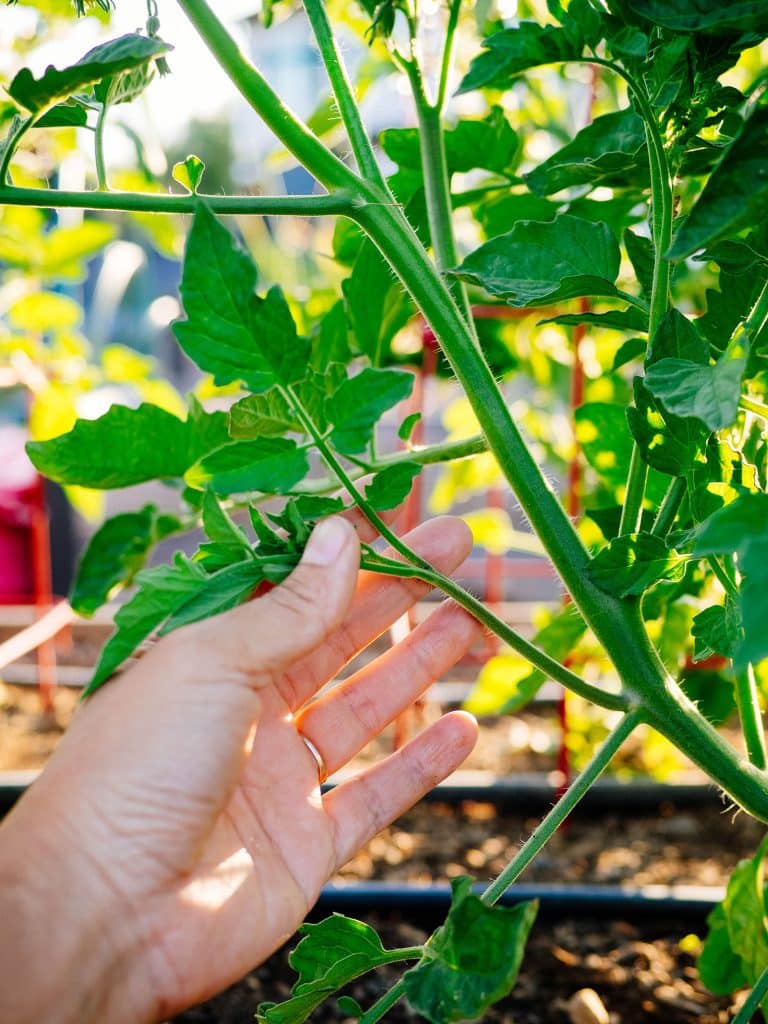

Of all the things that can go sideways with your tomato plants, leaf curl seems to be the most common. Even healthy plants may occasionally roll their leaves upward, leading you to think there’s something ominous happening.
The good news is that while there’s a number of reasons tomatoes curl their leaves, few of them are serious. They just love to keep us on our toes!
Don’t look at your tomatoes the wrong way, because these garden divas are highly sensitive to environmental factors like light intensity, temperature, moisture, nitrogen, and more. So if your plant is suddenly curling its leaves, fear not—it’s usually a simple fix to get them back to normal.
Take a closer look and compare your plant’s leaves to the images below. What direction do they roll: upward or downward? Which leaves are rolling: new leaves, old leaves, or all of them? Are there any other symptoms present, like yellow or spotted leaves, split stems, or malformed fruit? These should clue you in on what’s really going on.
Physiological leaf curl
Remember when I said tomatoes are divas? This tendency to (over)react is a natural survival instinct when they sense something going awry. A defense mechanism. A way for your plants to slow down transpiration, retain moisture, and conserve energy.
When this happens, you usually see it in the lower leaves first with an upward cupping of the edges followed by a lengthwise rolling of the leaves toward the center. The curled leaves tend to thicken or take on a leathery texture, but otherwise remain green. If the situation doesn’t improve, then the whole plant might become affected.


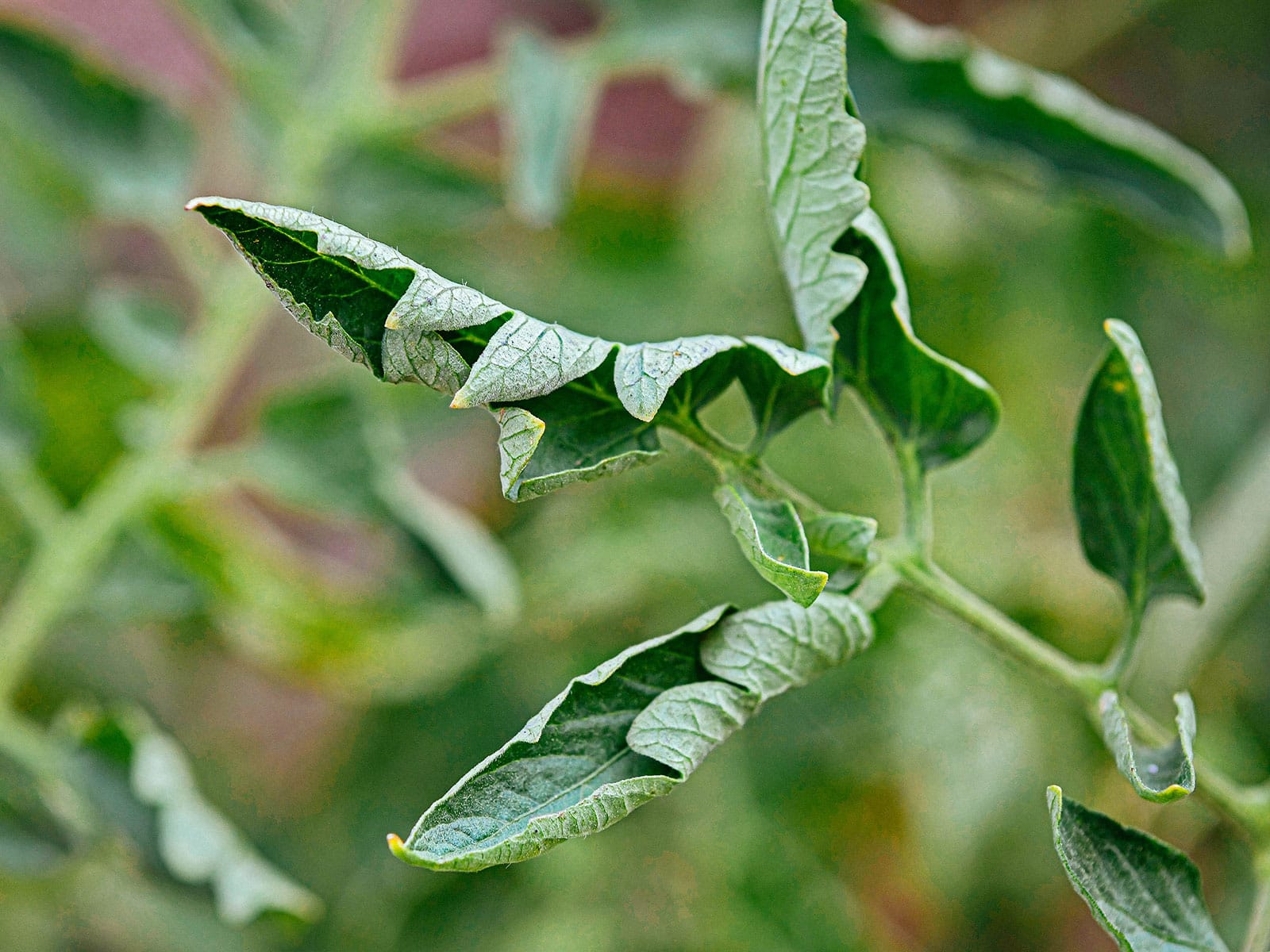
A tomato plant exhibits physiological leaf curl when it experiences transplant shock, over-fertilization with nitrogen, heat stress, drought stress, root damage, excessive pruning, or intense sunlight. This sometimes happens early in the season when we handle or fertilize our tomato plants more, but it’s also common during a heatwave or in areas with full summer sun exposure.
Fortunately, physiological leaf curl is easy to correct or even prevent. You can lessen the chances of leaf curl with a few simple strategies:
- Properly harden off tomato seedlings before transplanting them in the garden
- Transplant tomatoes when soil temperatures are at least 60°F and air temps are consistently above 50°F
- Mulch around your plants to maintain soil moisture
- Don’t let the soil dry out too much between watering sessions (and definitely don’t flood your plants out of panic if you forget to water for a week)
- Avoid high-nitrogen fertilizers that force a quick flush of weak new growth
- Avoid damaging the roots or pruning too many branches
- Give your tomato plants some shade if temperatures soar above 85°F
- In hot climates, plant your tomatoes in a spot where they get afternoon shade
Related: How and where to hang shade cloth to protect plants in summer
Tomatoes with rolled leaves usually grow out of it as they mature or when conditions stabilize, so put down the fertilizer (especially in the heat of summer) and try to keep your plants at a comfortable temperature.
Ethylene gas injury
Greenhouse-grown tomatoes are prone to epinasty, a botanical term that refers to the pronounced downward curvature of a leaf and petiole. So rather than curling up, the leaf and stem curl down.


Epinasty is caused by malfunctioning or poorly vented greenhouse heaters. If there’s incomplete combustion of the gas or the exhaust from a propane or methane heating system is obstructed, ethylene (an odorless gas) can form and injure tomato plants.
Even low concentrations of ethylene can cause growth issues in tomatoes, including curling or twisting of leaves and stems, yellowing or wilting leaves, stunted development, premature leaf aging, and leaf drop or blossom drop (in the most extreme cases).
Did you know?
Ethylene is also a naturally occurring plant hormone that triggers physiological responses, but not all of them are bad—it depends on whether the ethylene is affecting vegetative plant tissues or fruits. Tomatoes actually require ethylene to ripen and they produce it internally to initiate the ripening process.
I occasionally see epinasty on nursery starts, where the lower (older) stems may bend downward but the upper (newer) stems grow normally once the plants were taken to a new environment. So, this is a problem that’s easily corrected.
If you suspect ethylene damage, have your heater serviced or move your tomato plants out of the greenhouse immediately.
Herbicide exposure
But wait! I don’t use herbicides in my garden!
You might not, but do your neighbors?
Tomatoes are super sensitive to growth regulator herbicides like 2,4-D and dicamba, and small droplets can travel long distances via wind.
Herbicide drift can happen if you live near farms or industrial areas that spray for weeds. If your neighbors or their landscapers use herbicides in their lawn care, that can also affect your vegetable garden.
But drift can sometimes come from a source that’s least expected: your mulch or compost.
Herbicide residue persists in contaminated straw and hay, as well as in the manure of livestock that grazed on pastures treated with herbicides. This is why it’s so important to know the source of your straw mulch or compost!
Sometimes, well-meaning farmers may tell you their composted manure is safe without realizing their horses fed on treated hay. Or the clerk at the feed store won’t know if their supplier sprays their field.
All I can say is this: Proceed with caution and try to do your homework before bringing home straw or compost. I’ve had the unfortunate experience of dealing with herbicide exposure in my own garden many years ago in California, and I had to replace most of the soil in my raised beds.
Severe herbicide damage appears after a few weeks as gnarled, twisted, or otherwise abnormal leaves and stems on your tomatoes. The stems may turn white or split, and the fruit may have catfacing or uneven ripening.


If you get “lucky” and the damage is mild, you can trim the wonky growth and let your plant grow out of it, but it’s 50/50 on whether it’ll produce a good harvest. (And do you really want to eat the fruit off an herbicide-damaged plant? Probably not.)
My recommendation is to remove the affected plants and throw them in the trash. Never compost them!
How do you know if it’s herbicide exposure vs. a tomato disease?
Look at your other plants. Peas, beans, peppers, strawberries, and grapes are especially sensitive to growth regulator herbicides and will show the same leaf distortion.
Plant viruses
Certain plant viruses cause leaf rolling, such as tomato yellow leaf curl virus (transmitted by whiteflies), tomato spotted wilt virus (transmitted by thrips), curly top virus (transmitted by leafhoppers), and tomato mosaic virus (spread by infected plants or tools).
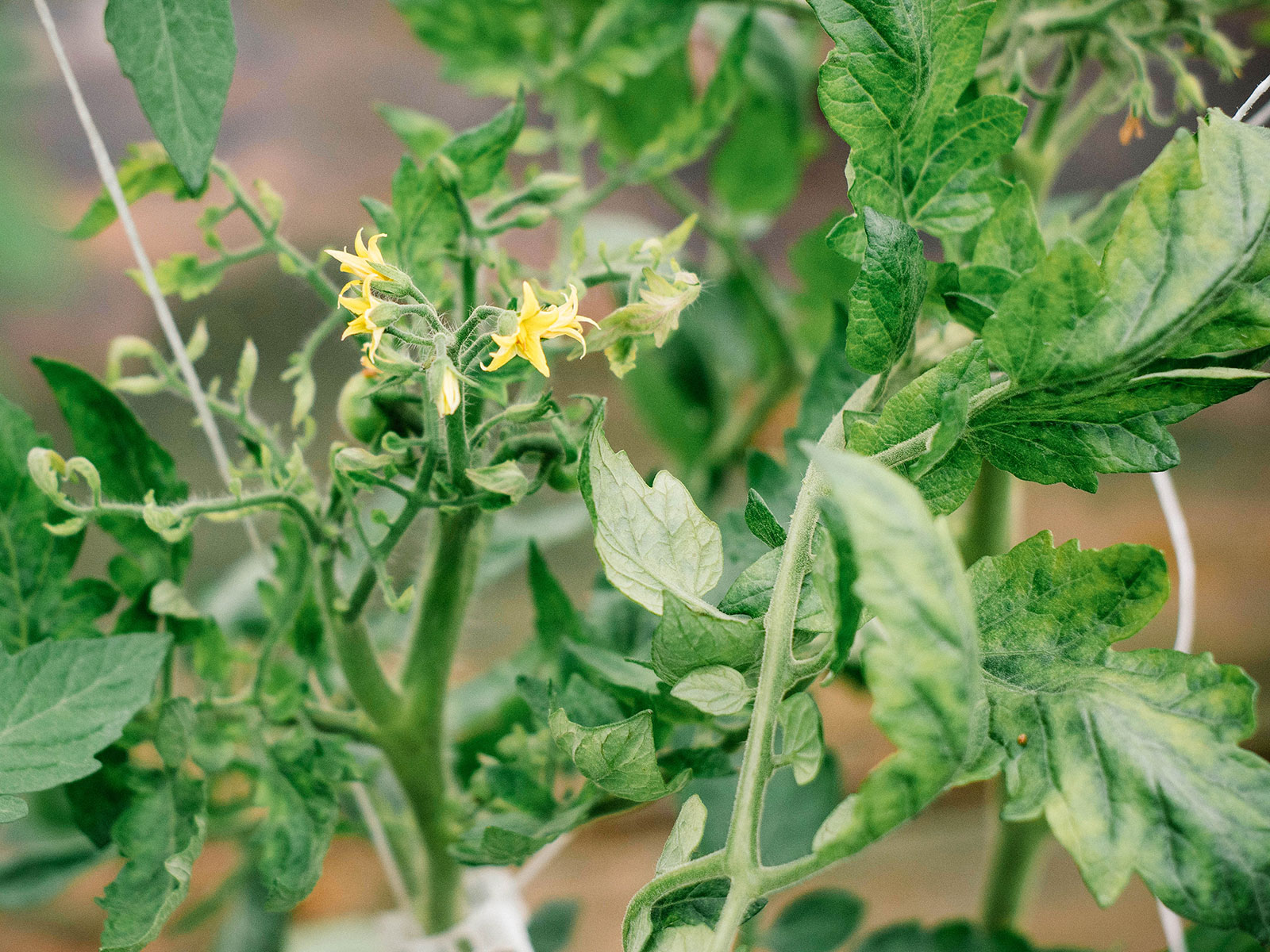

Other symptoms help distinguish these viruses from physiological or herbicide-induced leaf curl, including:
- Pale or splotchy leaf edges
- Mottled or patchy bronzed leaves
- Crinkled or crumpled appearance
- Purplish veins on the undersides of leaves
- Brown sunken spots or streaks on stems
- Ring spots on the outside of the fruits
- Browning on the inside of the fruits
- Overall poor fruit production

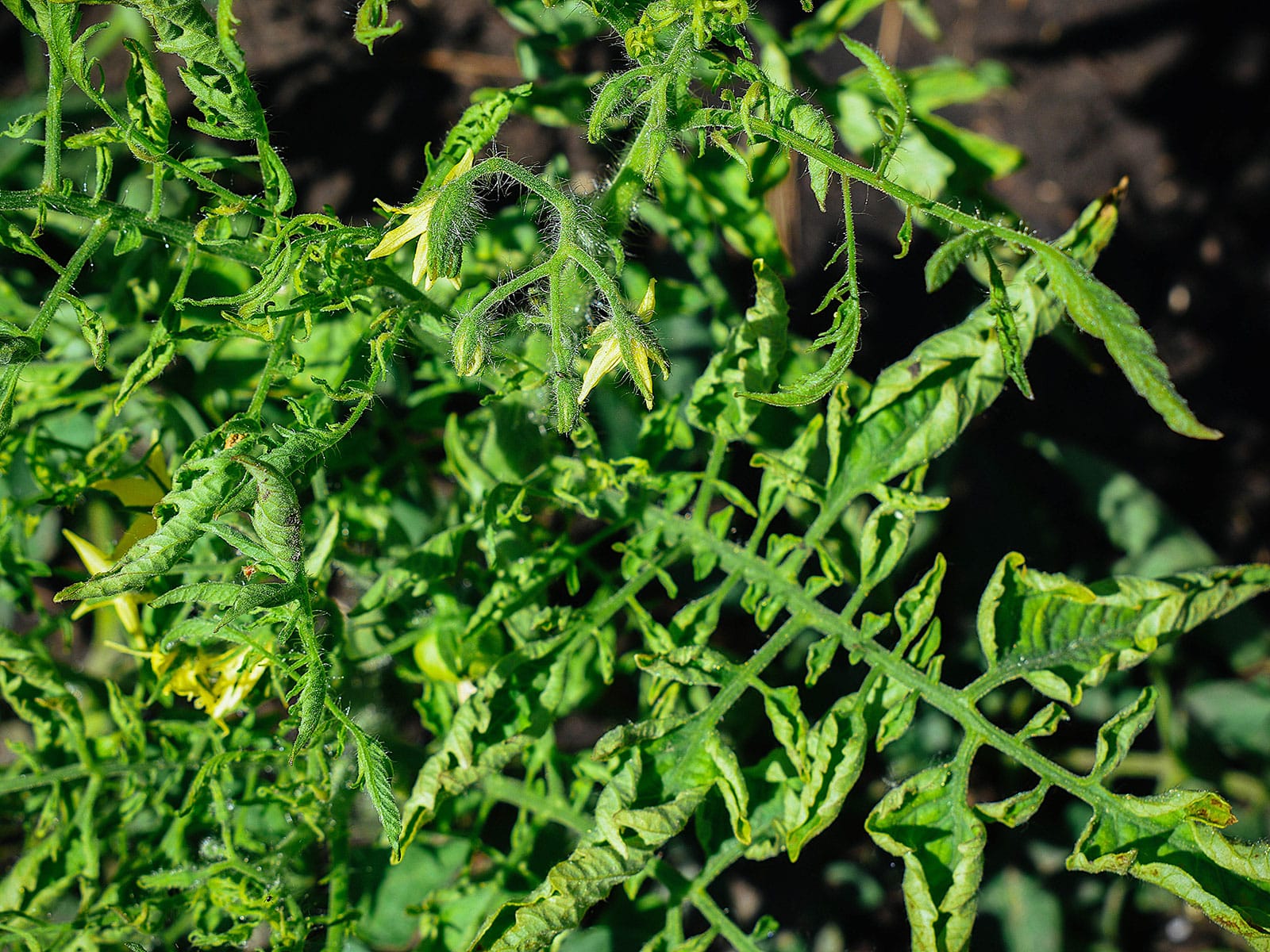
While physiological leaf curl typically occurs near the base of the plant on the older leaves, viruses cause leaf curl across the whole plant.
If your leaf curl problems aren’t solved by any of the previous fixes, you might be dealing with a virus and there’s no cure or chemical treatment for virus-infected tomato plants.
Your only option is to remove the plant (and its roots) and throw everything in the trash so the virus doesn’t spread to your other (healthy) plants.