
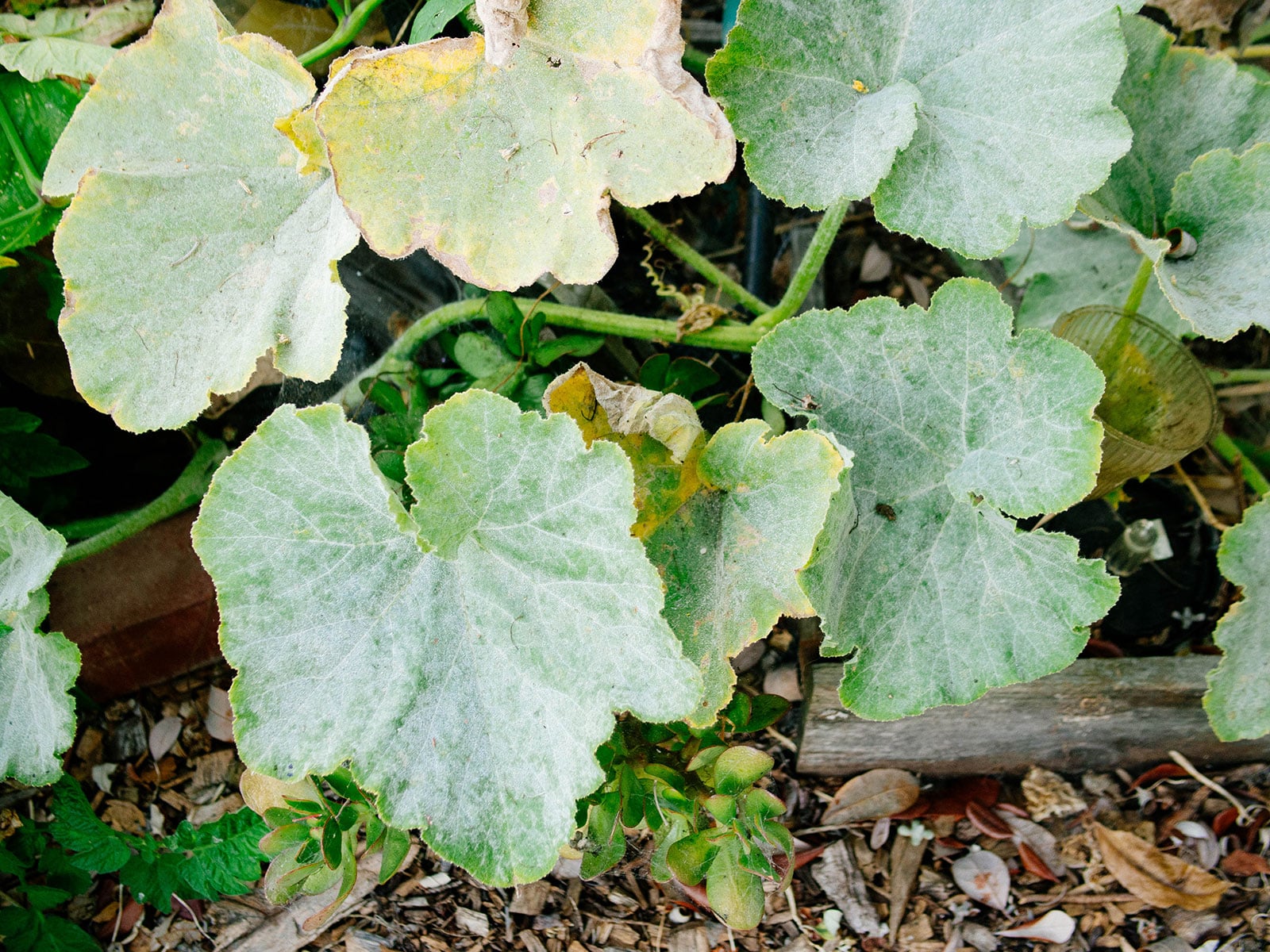
If you grow zucchini, pumpkins, cucumbers, or melons, you’re probably familiar with powdery mildew. It’s one of the most recognizable plant diseases that affects flowers and fruits too.
Powdery mildew seems to hit my garden hardest in mid to late summer when I see the chalky white coating on my bee balm (Monarda). It’s there some years and others not.
And while a mild infection generally doesn’t do much damage if you catch it early, powdery mildew spreads fast and a severe case can stunt plant development, cause heavy leaf drop, and lead to fewer flowers or poor fruit quality.
You definitely don’t want to ignore it, but the home remedy you often read about online (using a diluted milk spray) isn’t always the best way to treat it. Here’s what to do instead if you want to control powdery mildew in your garden.
Disclosure: If you shop from my article or make a purchase through one of my links, I may receive commissions on some of the products I recommend.
It starts with prevention
I know, I know, you’re here for the treatment plan but the first step to controlling powdery mildew is keeping it from happening in the first place. Waiting for the first visible symptoms before you act is a losing strategy.
So first: know the type of environment that helps powdery mildew flourish.
Contrary to popular belief, powdery mildew does not establish on wet leaves or thrive in rainy climates. The disease actually prefers a dry leaf surface.
What does make powdery mildew spread more rapidly is high ambient humidity combined with moderate temperatures (between 60°F and 80°F). According to UC IPM, 90-plus-degree summer heat in hot inland climates will kill spores. But cool nights, coastal fog, or poor air circulation among your plants all create near-ideal spore germination conditions.

While you can’t control the weather, you can control the amount of air flow that helps slow or reduce the incidence of disease. Dense plantings combined with stagnant, humid air create a mildew-favorable microclimate, even if you don’t live in a particularly humid climate.

So before you reach for a spray bottle…
- Plant powdery mildew-resistant varieties of squash, melons, and cucumbers (look for “PM Resistant” or “PMR” on the labels)
- Give more space between your plants than the seed packets suggest
- Prune and stake your zucchini to open up the canopy
- Avoid excessive watering (especially in the evening) that can raise local humidity or splash fungal spores onto leaves
- Avoid high-nitrogen fertilizers on susceptible plants, as powdery mildew easily infects the fast-growing, weak, lush new leaves (opt for a more balanced, slow-release fertilizer instead)
Where to buy
PM resistant melons
Where to buy
PM resistant cucumbers
Where to buy
PM resistant squash
Sprays that actually work for powdery mildew
The goal with getting powdery mildew under control is not to eliminate it, but to manage it at a level where your plants can stay productive through the season. Rarely does powdery mildew destroy an otherwise healthy crop—although it may reduce yield or just look unsightly. So the decision to keep treating an infected plant versus pulling it out depends on how much of the season remains.

Dahlias with three months left to bloom? Worth trying one of the sprays below. Zucchini that’s three-quarters covered in powdery mildew in September? Honestly, it’s probably ready for the compost heap soon anyway.
Potassium bicarbonate
The most effective and widely available treatment for powdery mildew contains potassium bicarbonate, an organic fungicide that kills spores on contact by raising the surface pH.
You can make your own spray by mixing 1 to 2 tablespoons of potassium bicarbonate (sold under the brand name MilStop) per gallon of water, and apply it to all leaf surfaces, including the undersides. Repeat application every 7 to 14 days.
Where to buy
Potassium bicarbonate
Mix 1 to 2 tablespoons per gallon of water and spray thoroughly on all leaf surfaces.
Sodium bicarbonate (baking soda)
Baking soda also raises leaf pH and helps inhibit spore germination, but it provides weaker residual protection than potassium bicarbonate. It works in a pinch, but repeated application risks accumulation of sodium in the soil, which can make the soil too alkaline for most plants to thrive. So, use this sparingly.
Mix 1 tablespoon baking soda per gallon of water with a few drops of castile soap and apply to all leaf surfaces. Repeat application every 7 to 14 days.
Where to buy
Sodium bicarbonate
Mix 1 tablespoon baking soda per gallon of water with a few drops of pure castile liquid soap.
Bacillus amyloliquefaciens
Bacillus amyloliquefaciens is a biological control that works best as a preventative treatment, rather than a cure. But if used early at the first signs of infection, Bacillus amyloliquefaciens (a beneficial bacterium) can activate the plant’s own defense system, block fungal spores from germinating on the leaf surface, and release natural compounds that break down and stop the fungi from reproducing.
Where to buy
Bacillus amyloliquefaciens
Shake well and mix this concentrate with water to spray onto affected plants.
Neem oil
Neem oil works differently than the other sprays on this list. Rather than preventing new infections, neem oil functions as an eradicant, reducing mild to moderate powdery mildew.
Follow the instructions on the label and apply in the evening or on overcast days to avoid leaf scorch. Don’t use neem if temperatures will exceed 90°F.
Where to buy
Pure neem oil
Mix this 100 percent cold-pressed neem oil extract with water and spray onto affected plants.
Whichever solution you use, I recommend rotating between a couple of them, every few applications, to avoid potential resistance build-up (and simply increase your chances of really knocking the infection down).
Keep in mind that no spray can “cure” an active infection. Infected leaves stay infected, and the white patches won’t disappear. What spraying does do is stop the spores from spreading and infecting new leaves. Over time, as your plant puts out new growth, the overall situation will improve.
Milk spray: does it work?
No doubt you’ve come across Reddit threads and other sites citing diluted milk spray as an easy-to-use home remedy for powdery mildew. The advice is so prevalent in gardening circles that it almost seems like folklore. So is it?

I was surprised to find out that milk spray does have roots in science. Brazilian researcher Wagner Bettiol published research in 1999 that studied fresh cow milk’s effectiveness in greenhouse experiments against powdery mildew. His results showed that a 10 percent milk solution was comparable to synthetic fungicide in suppressing powdery mildew on zucchini.
While the mechanism is still debated, his findings suggest that milk proteins and fats may form a physical barrier on leaves that stops the fungi from growing.
Interesting for sure, but keep in mind his research trials were conducted in greenhouses in warmer and drier conditions. Your own climate and the microclimate in your garden may be different. (Diluted milk sprays never worked for me when I lived on the Southern California coast.)
Nevertheless, milk is an easy experiment to try if you already have it around and disease pressure is low. The concentration can be anywhere from 10 to 40 percent milk (mixed with water), applied once a week.
The most susceptible plants
Powdery mildew commonly affects the cucurbit family (summer squash and winter squash, cucumbers, and melons), certain flowers (including, but not limited to, azaleas, bee balm, dahlias, delphiniums, peonies, phlox, roses, and snapdragons), and even fruits (such as apples, blueberries, and grapes).


What many gardeners get wrong is how the disease spreads through a garden. Powdery mildew is not one disease, but a group of related fungal species that are adapted to infect specific plant families. So the powdery mildew that infects your zucchini cannot infect your roses. (Whew!)
The bad news? Powdery mildew on zucchini can spread to cucumbers and other cucurbits. The good news is that potassium bicarbonate, baking soda, Bacillus amyloliquefaciens, and neem oil all work to control the different species of fungi that cause powdery mildew, so you can use the same solution for any plant that’s infected.
Should you remove infected leaves?
If you catch an infection early before it’s spread too much, you can definitely remove the infected leaf and discard it in the trash (not the compost) to reduce the spore load. Just be careful not to remove too many leaves at once, as this can negatively affect plant growth.
Are you sure it’s powdery mildew?
Maybe this disclaimer belongs in the beginning of this post, but I do want to mention it just in case…
Powdery mildew is distinctive and easy to spot because your leaves will look like they’ve been sprinkled with flour.
But while you can easily tell powdery mildew apart from other fungal diseases, certain varieties of squash have variegated leaves that sort of mimic the dusty white pattern.
If you look more closely, however, you’ll notice three main differences.
Appearance: Natural leaf variegation features smooth, flat, silvery splotches that follow a consistent pattern along the leaf veins, while powdery mildew appears as fuzzy or blotchy white spots that look like flour or powdered sugar.
Location: Natural leaf variegation is found only on the top side of the leaves, while powdery mildew shows up everywhere, including the underside and stems.
Touch: Natural leaf variegation cannot be rubbed or wiped off, while powdery mildew comes off easily on your fingers.
Examples of powdery mildew


Examples of natural leaf variegation


So before you freak out, check your seed packet to make sure you didn’t plant one of those variegated types!
(Also, don’t confuse powdery mildew for downey mildew, an entirely different disease characterized by yellow blotches on the leaf surface and fuzzy mold on the underside. Treating one will not address the other.)