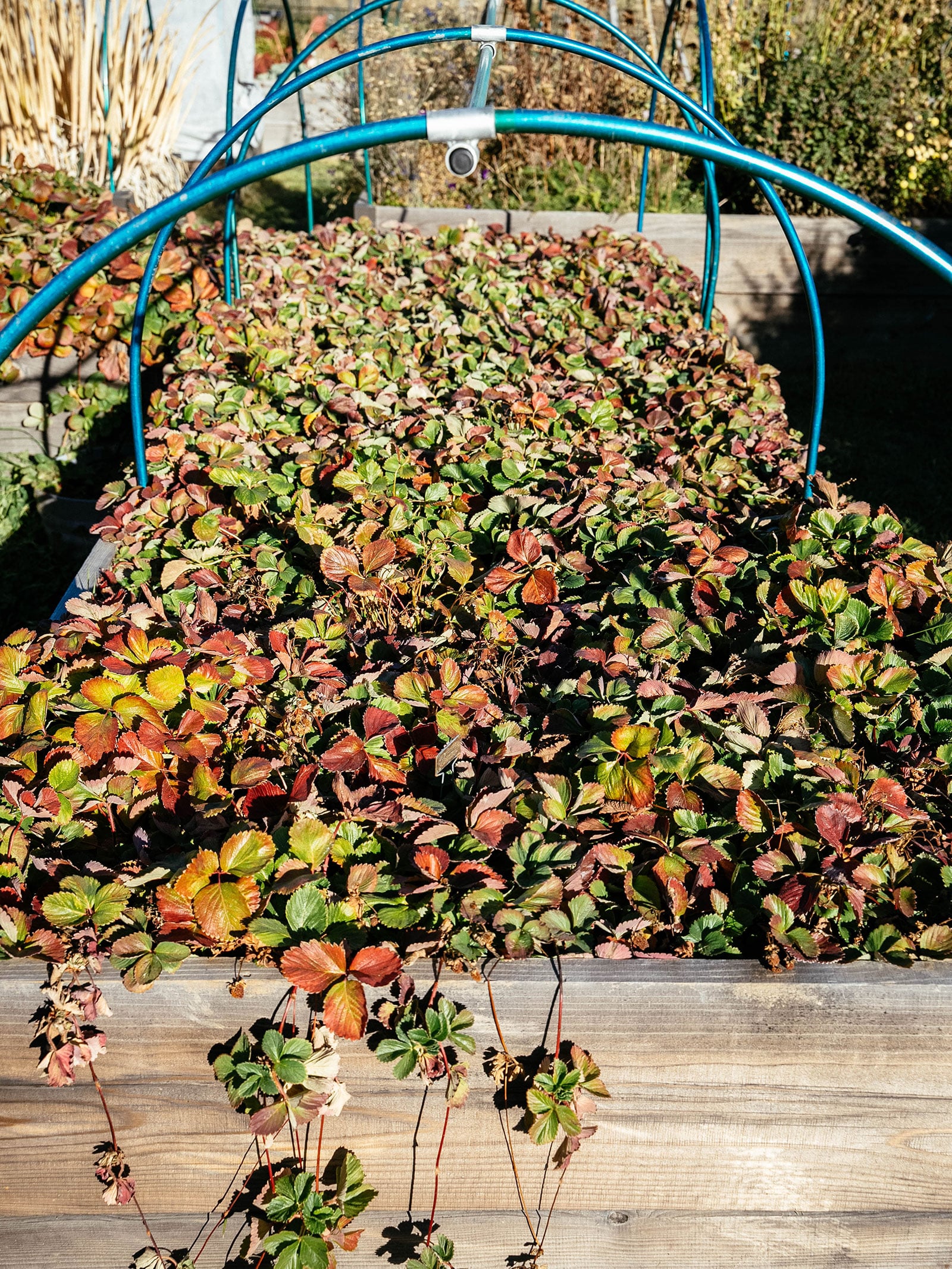
Every fall, the same advice makes the rounds: Pile straw on your strawberries before winter or lose them. And every fall, a lot of well-meaning gardeners do exactly that—a few weeks too soon.
Winterizing strawberries means protecting the crown through the coldest months, usually with a loose layer of mulch or frost cloth. (The crown is the short, thick stem at the base of the plant where the leaves, roots, flowers, and runners all grow from.)
It’s also where next year’s flower buds are tucked away, since strawberries set those buds in late summer and fall as the days get shorter. Protect the crown, and you protect next spring’s berries.
So who needs to bother? If your winter lows regularly dip below 20°F, which is roughly USDA zone 7 and colder, your strawberries need at least some help. In zones 8 and warmer, your plants may never fully go dormant, and the most you’ll do is throw a frost cover over them during a rare cold snap. (Not sure what zone you’re in? Just enter your zip code on my USDA Plant Hardiness Zone lookup tool.)
The trick to winterizing strawberries isn’t doing more. It’s doing it at the right time. Here’s how to tell when that is, what most people get wrong, and why my own strawberry bed looks like a total mess all winter—on purpose.
When to start winterizing strawberries
Strawberries are tougher than they look. Once they’ve hardened off for winter, dormant crowns can handle temperatures down to about 20°F without any protection, and a blanket of snow insulates them even better than straw does. (A foot of snow is basically a free down comforter.)

Below 20°F, unprotected crowns, roots, and flower buds start to take damage, and the damage gets worse with every few degrees the temperature falls. Somewhere in the mid-teens, an unprotected crown can be terminated outright.
The catch is the word dormant. A strawberry plant needs a few weeks of steadily cooling weather to harden off—to slow its growth, pull its energy down into the crown, and build up its cold tolerance. Cover it before that process finishes, and you interrupt it.
Signs your strawberries are dormant

Look at the leaves. Over the course of fall, you’ll notice the plants:
- Change color: Green leaves turn red, purple, or bronze as temperatures drop. (Some varieties flush a deep burgundy, while others just go dull.)
- Flatten out: The plant hunkers down, with its leaves lying low and close to the soil instead of standing upright.
- Stop growing: No new leaves unfurl from the center of the crown, and runners stop forming.
- Go limp after a few hard frosts: Older leaves turn brown, floppy, and a little sad-looking.
When most of your bed looks like this, your plants are ready to be tucked in.
The temperature rule
Strawberry leaves tell you the plant is ready. But your actual weather tells you it’s time. Cover your strawberries when either of these happens:
- The soil freezes: The top 1/2 inch of soil is frozen solid.
- The nights stay cold: Nighttime lows have hovered around 20°F for several nights in a row.
In most cold-climate gardens, that lands somewhere between early November and early December. In northern Iowa, for example, strawberry beds typically get mulched in early November, while gardeners a few hundred miles south might wait until after Thanksgiving. Go by your thermometer, not the calendar. An unusually warm fall can push the timing back by weeks.
Quick tip
Not sure if your soil is frozen? Push a trowel into the bed first thing in the morning. If it won’t go in more than about 1/2 inch without real effort, the top layer is frozen.
The mistake most people make: Winterizing too early
Maybe you’ve done this or heard you should: piling on mulch at the first sign of frost.
I get the impulse. The first cold snap of fall feels urgent, the straw bale is sitting right there, and covering the bed feels like the responsible thing to do. But strawberries don’t need protection from the first frost. They need it from the deep, sustained cold that shows up weeks later—and covering them too soon creates more problems than it solves.

Here’s what can go wrong:
- The plants never fully harden off: Mulch holds warmth in the soil, which tells the plant it’s still early fall. Instead of settling into dormancy, it keeps putting out soft new growth, and that growth is the first thing to die when real cold arrives. Mulching a plant that’s still actively growing can make winter injury worse, not better.
- The crowns stay wet: A thick layer of straw over damp soil and still-green leaves can set the stage for crown rot and other fungal problems, especially in a rainy fall.
- You invite houseguests: A cozy pile of straw over not-yet-frozen ground looks like prime winter housing to voles and mice (and they won’t say no to a strawberry crown snack while they’re at it).
The plant that got tucked in early often comes out of winter in worse shape than the one that was left alone for a few extra weeks. So, patience is the trick here.
Subscribe to Garden Betty
Sign up to get my free weekly emails and I’ll teach you how to keep your plants alive, maximize your garden bounty, and preserve the harvest.
How to winterize strawberry beds
Winterizing a strawberry bed comes down to a quick fall cleanup and, depending on where you live, a loose layer of mulch.
1. Pull the weeds
Weeds compete with your strawberries for water and nutrients, and plenty of perennial weeds keep growing well into fall while your strawberries are winding down. Pull them now, while the soil is still soft, and you’ll have far fewer to fight when everything wakes up in spring. (Bonus: Fewer weeds means fewer places for slugs and other pests to hide over winter.)
2. Remove diseased leaves—but leave the rest
Look for leaves with purple-rimmed spots, brown and scorched-looking edges, or a fuzzy gray coating. Those are signs of common fungal diseases like leaf spot, leaf scorch, and gray mold, and their spores can overwinter on infected foliage. Snip those leaves off at the base and toss them in the trash (not the compost pile).
Everything else? Leave it.
That tangle of old leaves and spent runners is actually helping your plant. As the foliage dies back, it collapses over the crown and forms a loose, breathable layer that buffers it from wind, cold, and the freeze-thaw cycles that can heave plants right out of the ground. Your bed will look overgrown, wild, and a little neglected all winter. And that’s okay! You can tidy it up in spring, after it’s done its job.
3. Cut back beds that had pest problems
The exception to the leave-it-alone rule is a bed that struggled with pests this year. Spider mites, aphids, and other small pests can overwinter as eggs or adults in old foliage and plant debris, ready to pick up right where they left off once the weather warms.
If that sounds like your bed, cut the foliage back to about 1 inch above the crowns with sharp shears (or a string trimmer, or a lawn mower on its highest setting for a large patch). Take care not to nick the crowns. Rake up every bit of the clippings and bag them for the trash. Since you’ve just removed the plants’ natural protection, plan on mulching those bare crowns once the timing is right.
4. Decide how much protection you need
What I currently do for my strawberry bed: not much! I’m in zone 5ish but our average winter lows typically stay in the low to mid 20s (Fahrenheit) with a couple weeks where it gets colder. I don’t tidy up the bed and I don’t add any mulch. I let the healthy leaves die back on their own, and they settle over the crowns as a natural mulch the plants make for themselves.
Depending on the winter, I might hang a medium-weight frost cloth over the bed if it’s unusually frigid or windy. (The upside to keeping frost cloth over my strawberry plants is that they start to wake up a bit earlier in spring.)

That works for my garden, but it isn’t a hard and fast rule so don’t simply go by your zone. The number to keep in mind is 20°F. Below that, an unprotected crown can be damaged, so if your winters regularly drop into the teens or single digits without dependable snow cover, give your plants extra insulation:
- Loose straw: Spread 3 to 5 inches of straw over the plants, going deeper the harsher your winter is. Shake it out by the handful rather than dumping it in clumps, since you want it fluffy enough for air to move through. It’ll settle to 2 to 4 inches. Raised beds and strawberry pyramids run colder than in-ground beds, so give those 6 to 8 inches.
- Frost cloth: A frost blanket pinned over the bed with landscape staples or rocks works well for small beds, or as an extra layer over the straw in very cold climates.
Remember to use straw, not hay. Hay is loaded with seeds, and you’ll be weeding grass out of your strawberry patch all summer.
Don’t use whole fall leaves
I know, I know—you have a yard full of free mulch falling out of the trees. But large, whole leaves are a poor choice for strawberries. They mat down into a dense, soggy layer that blocks air and traps moisture, and that can smother and rot the plants underneath.
If leaves are all you have, shred them first. Run them over with a lawn mower a couple of times (or feed them through a leaf shredder) until the pieces are about the size of a quarter. Shredded leaves stay loose, so air and water can get through the way they do with straw.
Read more: My favorite ways to use fall leaves to enrich the soil
Winterizing strawberries by USDA zone
|
USDA zone |
Average coldest winter low |
Fall cleanup |
Winter protection |
When to cover |
|---|---|---|---|---|
|
8–10 |
10°F to 40°F |
Pull weeds, remove diseased leaves |
None needed; plants may stay semi-evergreen. Use frost cloth during a rare hard freeze. |
Only when a hard freeze is forecast |
|
7 |
0°F to 10°F |
Pull weeds, remove diseased leaves, leave healthy foliage in place |
Healthy foliage is usually enough. Add frost cloth or 2 to 3 inches of straw when lows drop below 20°F. |
When cold snaps below 20°F are forecast |
|
5–6 |
−20°F to 0°F |
Pull weeds, remove diseased leaves, leave healthy foliage in place |
Healthy foliage may be enough with reliable snow cover. Otherwise, add 3 to 4 inches of straw or frost cloth. |
Mid-November to early December, after the soil freezes |
|
3–4 |
−40°F to −20°F |
Pull weeds, remove diseased leaves, leave healthy foliage in place |
4 to 5 inches of straw (6 to 8 inches in raised beds); use frost cloth on top in exposed, windy spots. |
Late October to mid-November, after the soil freezes |
The timing in this table is approximate. Let your soil and your thermometer be the real guide.
Subscribe to Garden Betty
Sign up to get my free weekly emails and I’ll teach you how to keep your plants alive, maximize your garden bounty, and preserve the harvest.
How to winterize potted strawberry plants
Strawberries in containers have it much harder than strawberries in the ground. In a garden bed, the surrounding soil insulates the roots. In a pot, the roots are exposed to the cold on every side, and strawberry roots aren’t as cold-hardy as the crowns. A potted plant left outside through a cold-climate winter can freeze solid and die, even if the same variety would sail through winter in the ground.

Once your potted plants have gone dormant (look for the same signs as above), pick the option that fits your space:
- Move them to an unheated garage or shed: This is the easiest fix. A cold, sheltered spot keeps the plants dormant while protecting the roots from the worst of the temperature swings. Water lightly about once a month so the soil doesn’t dry out completely, but don’t keep it wet.
- Bury the pots: Dig a hole in an empty garden bed, sink the whole pot so the rim sits at soil level, and mulch over the top as you would an in-ground plant. The garden soil does the insulating for you.
- Huddle and wrap: Group the pots together against a sheltered wall, pack straw or bags of shredded leaves around and between them, and cover the tops with frost cloth.
Whatever you do, don’t bring potted strawberry plants into the house. A warm living room will wake them up too early, and strawberries do best with a cold, dormant rest before they flower and fruit again.
If you garden in zone 8 or warmer, you can usually leave potted strawberries right where they are. Just slide them against a wall or throw a frost cover over them when a hard freeze is in the forecast.
And if your strawberries are in a strawberry jar or hanging basket, and none of these options is practical? It’s okay to treat them as annuals. Compost the plants in fall, store the empty container indoors, and replant with fresh plants in spring.
Read next: How to plant bare-root strawberries in spring
Avoid disturbing dormant plants
Once your strawberries are covered, leave them covered—even when a January warm spell has you itching to peek.
Mulch isn’t there to keep the plants warm. It’s there to keep them consistently cold. The real threat in winter isn’t one frigid night, it’s the back-and-forth of thawing and refreezing. Every time the soil thaws and freezes again, it expands and contracts, and that movement can heave crowns right out of the ground, tearing roots and leaving the plants exposed to drying winter winds.
Pulling the mulch back on a sunny 50°F afternoon lets the soil warm up, which can coax the crowns out of dormancy. That tender new growth (and any early flower buds) won’t survive when temperatures crash again the following week.
Let sleeping strawberries lie.
If you notice a plant has heaved partway out of the soil, gently press it back down once the ground thaws enough to let you, then tuck the mulch back around it.
Subscribe to Garden Betty
Sign up to get my free weekly emails and I’ll teach you how to keep your plants alive, maximize your garden bounty, and preserve the harvest.
What to do in spring
Uncover the plants when new growth appears
Start checking under the mulch once the worst of winter has passed. Pull back a handful, and if you see new leaves emerging from the crowns (they’ll look pale yellow or almost white from growing in the dark), it’s time to uncover. A good rule of thumb is to wait until about a quarter of your plants are showing new growth.
Related: How to use mulch more effectively in your garden
Depending on your climate, that can be as early as February in mild-winter areas or as late as mid-April in northern regions. Rake the mulch off the plants and save it for your other beds, where the straw will keep early spring weeds down. If you left the bed wild and woolly like I do, now’s the time to clear away the dead foliage and old runners, since they’ve done their job.

Don’t jump the gun though. Uncovering too early nudges the plants to bloom early, and early blooms are the ones most likely to get caught by a late frost.
Fertilize everbearing and day-neutral strawberries only
Everbearing and day-neutral varieties produce fruit over a long stretch of the season, so they benefit from a feeding in late winter to early spring, right as new growth appears.
Junebearing strawberries are different: skip the spring fertilizer for these. A spring dose of nitrogen goes into leaves instead of fruit, giving you lush foliage, soft berries that rot easily, and more trouble with diseases like gray mold—often with a smaller harvest to show for it. Feed Junebearers after harvest instead, so the nutrients go to work in late summer and early fall, when the plants are setting flower buds for next year’s crop.
Keep frost cloth handy
Even after the mulch comes off, your strawberries aren’t in the clear. Open flowers are damaged at about 30°F, and young green berries at about 28°F, so a single late frost can take out a chunk of your harvest. You’ll see the damage the next morning when your strawberry flowers have a black center instead of a yellow one.
When frost is in the forecast, drape frost cloth over the bed in the afternoon so it traps some of the day’s warmth, or rake that mulch you saved back over the plants for the night. Uncover them the next morning so they get sunlight.
If you grow everbearing or day-neutral varieties, there’s a silver lining if the plants get nipped by frost. They keep sending up new flower clusters throughout the season, so losing the first round of blooms to frost isn’t the end of your harvest. Junebearers only get one shot, which is why frost protection matters most for them.
Plant late bloomers if spring frost is a constant battle
If your last frosts tend to hang on late into spring, consider Junebearing varieties that bloom later in the season. Lateglow, Seneca, and Sparkle all flower late and usually escape frost damage, which makes them good picks for northern gardens and frost-prone low spots.
Further reading: Why planting the right strawberry type matters
So this fall, pull the weeds, snip the sick leaves, wait for the real cold, and then (only then!) tuck your plants in. Your strawberries will do the rest.